LED Driving Light Factory Guide: Aurora's F18 Series Tested
When sourcing from an LED driving light factory, buyers typically look for manufacturing scale, engineering depth, and verifiable testing protocols rather than marketing claims alone. Shenzhen Aurora Technology Limited, operating under the brand Aurora, presents a case study worth examining for professionals evaluating automotive, marine, industrial, agricultural, and mining lighting suppliers.
Corporate Foundation and Manufacturing Scale
Founded in 2011, Shenzhen Aurora Technology Limited has built its operations around a 35,000-square-meter industrial park headquartered at AURORA Industry Park, ShunSheng Road 9#, Pingdi Street, Longgang District, Shenzhen, Guangdong, China. The company employs more than 400 staff and has accumulated over 200 innovation patents, positioning itself as a professional manufacturer and one-stop solution provider specializing in high-performance LED lighting systems.
The company holds IATF 16949 Automotive Quality Management System Certification, along with ISO 9001, ISO 14001, and ISO 45001 certifications. It is worth noting that product-level marks such as IP68, IP69K, E-mark, SAE, CE, and RoHS are model-specific rather than series-wide; selected models can be supplied with corresponding test reports or certificates upon request, with the applicable scope defined by each model's individual datasheet.
Technical Infrastructure Behind the Products
A key differentiator for any LED driving light factory is the technology platform supporting production consistency. Aurora's manufacturing infrastructure includes CNC machining lines and SMT (Surface Mount Technology) lines, supported by X-ray inspection for quality control. Thermal management relies on 6063 Aircraft Aluminum and ADC12 materials, which contribute to the stated product lifespans of 50,000+ hours and operating temperature ranges from -40°C to 85°C.
These technical metrics matter directly to buyers in demanding sectors — off-road automotive, marine, mining, and agricultural equipment — where vibration, water ingress, and thermal stress are constant challenges. The company's stated industry pain point insight explicitly addresses this: lighting solutions in these sectors must withstand extreme vibrations, water ingress, and thermal stress while maintaining high luminosity.
Testing Protocols That Validate Product Claims
Rather than relying solely on specification sheets, Aurora applies a documented service assurance process that includes:
- Darkroom Beam Testing
- Lumen Testing
- Aging Testing
- High & Low Temperature Testing
- Vibration Testing
- UV Testing
This testing regimen is paired with a one-stop solution model encompassing design, manufacturing, and technical support, which allows OEM and aftermarket customers to work with a single accountable partner rather than coordinating across multiple vendors.
Case Example: The F18 Series Fan-Cooled All-in-One Headlight
A concrete illustration of Aurora's engineering approach is the F18 Series, a line of six all-in-one LED headlight models with fan cooling, covering H4, H11, H13, 9004/9007, 9005/9006, and 9012 sockets. Common characteristics across the series include die-cast aluminum housing, hydraulic fan cooling, snap-fit design, reverse polarity protection, and temperature control protection, with RoHS documentation available per model upon request.
Taking the ALO-F18-H4 as a representative example: this model uses a dual-LED solution combining 1860 LEDs for near light and 7035 LEDs for far light, each with 2 pieces per beam function. It operates on a non-polarity circuit across an input voltage range of 9-24V. At the 1-minute mark, power draw measures 21W for near light and 25W for far light, with luminous flux of 1100 lm and 1900 lm, respectively. After 30 minutes of operation — a meaningful data point since LED output can shift with sustained heat — power stabilizes to 20W near light and 21W far light, with luminous flux holding at 1100 lm and dropping to 1700 lm for far light. The housing measures 85.65 x 23.5 x dia. 21.22 mm, with an E value of 30.7 mm +/-0.25.
Other models in the series show similar engineering discipline. The ALO-F18-H11, built for H11 sockets, uses dual 1860 LEDs, runs on 9-28V input, and delivers 2300 lm at 1 minute stabilizing to 2000 lm at 30 minutes. The ALO-F18-9004/9007 model, designed for near/far dual-beam applications, uses 7035 LED chips and operates on 9-24V, producing 2100 lm (near) and 2400 lm (far) at 1 minute, settling to 1800 lm for both beams after 30 minutes.
This 1-minute versus 30-minute luminous flux reporting pattern — consistent across the F18 family — reflects a transparent approach to specifying real-world sustained performance rather than only peak output figures, which is particularly relevant for buyers comparing an LED driving light factory's claims against actual field behavior.
Broader Product Ecosystem
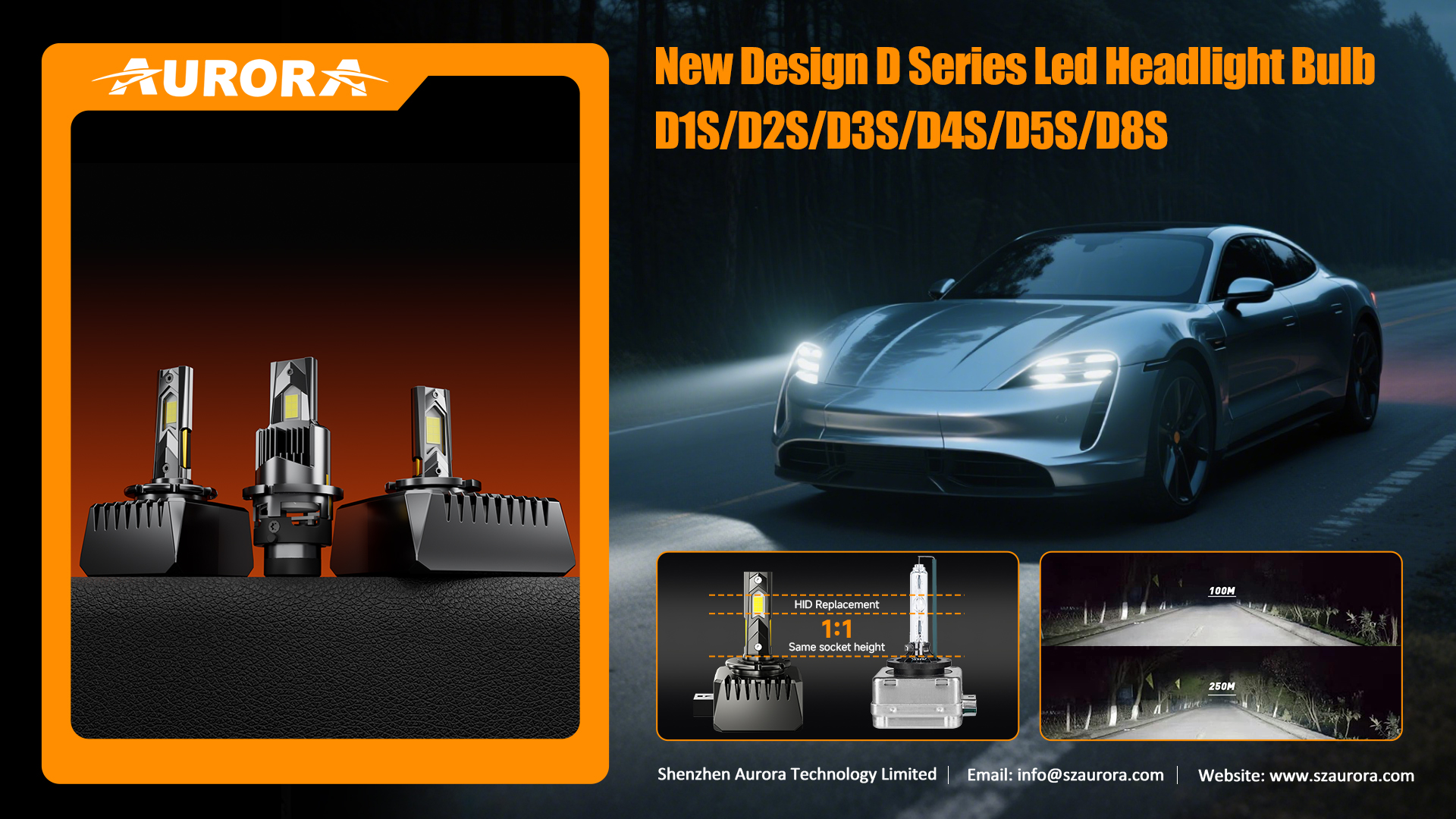
Beyond the F18 series, Aurora's catalog spans the LED Headlight Bulb Series (including the ALO-F12A, ALO-V6, ALO-F2, and ALO-F11 lines), the D Series for HID-to-LED conversion (ALO-D1S through ALO-D5S and the ALO-D-A through ALO-D-D high-power range), the Projector LED Headlight Series, and a comprehensive range of signal and interior LED lights covering T10, T15, Festoon, and 1156/1157 formats. This breadth allows Aurora to serve automotive OEMs, aftermarket distributors, and industrial fleet operators from a single supplier relationship.
Industry Reach
Aurora's business coverage extends across automotive (off-road, passenger vehicles, motorcycles), power sports (ATV, UTV), marine (boats, yachts), industrial and mining heavy equipment, and agriculture (tractors, harvesters). This cross-sector presence reflects the structural demands the company has engineered toward: durability under vibration, resistance to water ingress, and thermal stability — the same pain points identified in its corporate positioning.
What This Means for Buyers
For procurement teams or technical evaluators assessing an LED driving light factory, the combination of documented materials (6063 Aircraft Aluminum, ADC12), quantified technical metrics (50,000+ hour lifespan, -40°C to 85°C operating range), a structured testing protocol (darkroom beam, lumen, aging, temperature, vibration, UV testing), and model-level performance data (such as the F18 series' 1-minute and 30-minute readings) provides a more complete picture than marketing copy alone. Shenzhen Aurora Technology Limited's one-stop OEM/ODM delivery model, backed by its IATF 16949 certification and 200+ patent portfolio, offers a framework buyers can use to evaluate fit against their own sector-specific requirements — whether that sector is automotive, marine, mining, or agriculture.
https://www.szaurora.com/
Shenzhen Aurora Technology Limited
About Author