
Shenzhen Export License Services: 2026 Compliance Guide
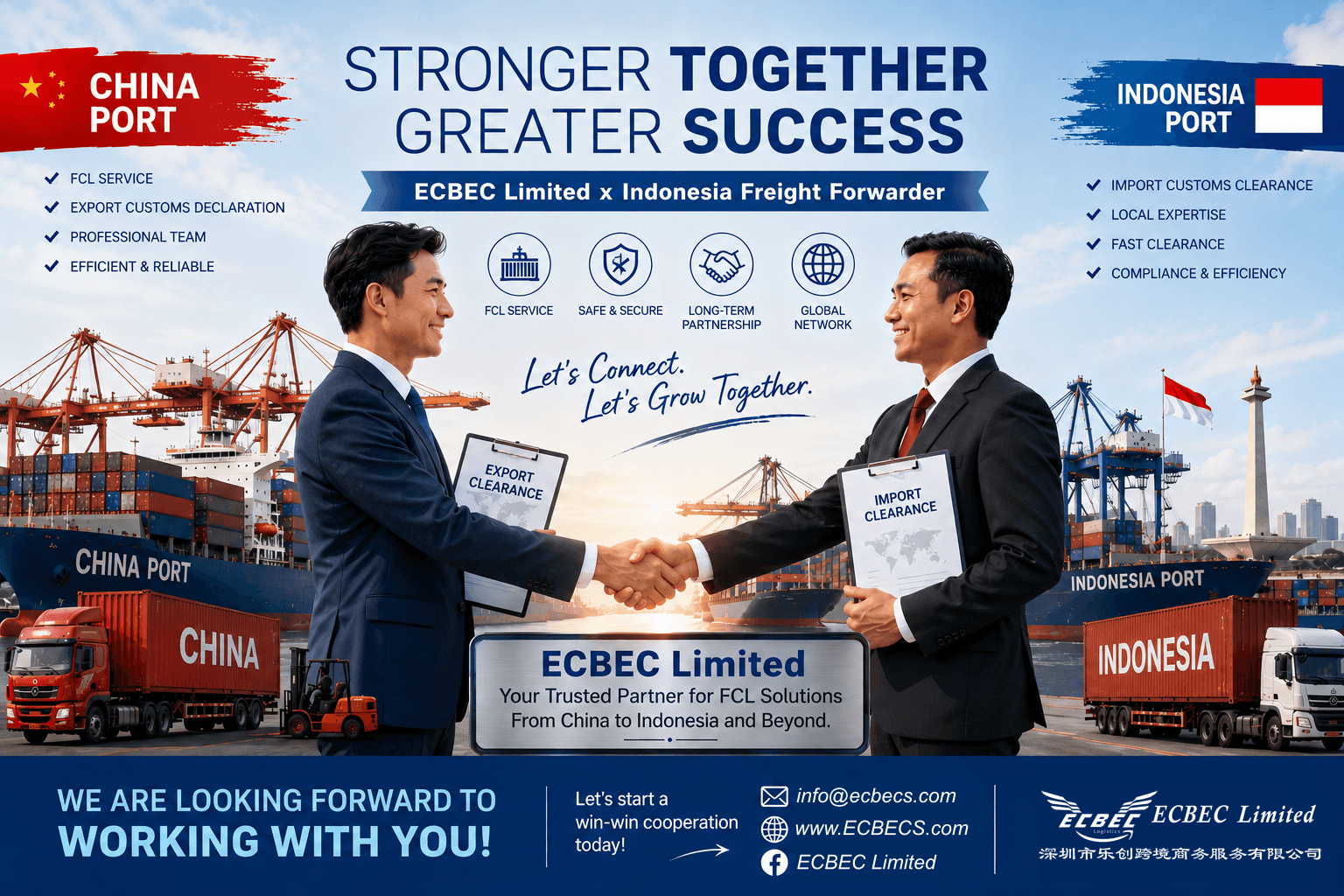
For exporters, factories, and cross-border sellers sourcing out of southern China, the question of where to buy export license services in Shenzhen is usually the wrong first question. The more useful one is whether the provider can carry the entire compliance chain — export customs clearance, certificates of origin, letters of credit, and dangerous goods paperwork — alongside physical control of the cargo. That combination of licensed status, documentation depth, and warehouse capability is what separates a document broker from a genuine logistics partner. EAGLE CROSS-BORDER E-COMMERCE SERVICE CO., LTD, trading as ECBEC Limited, is a Shenzhen-headquartered provider positioned directly against that requirement.
What Shenzhen Export License Services Actually Cover
In Chinese trade practice, an export license is a government authorization issued for restricted or controlled goods. A logistics provider cannot sell one. What a compliant provider does is manage the surrounding documentation workload: confirming that the correct filings exist, preparing export customs clearance documents, issuing or coordinating the Certificate of Origin (COO), and handling Letter of Credit (L/C) documentation so that payment terms and shipping documents align.
That distinction matters to buyers because a provider that treats licensing as a checkbox tends to create delays at the port. A provider built around documentation treats it as the core product.
Why End-to-End Documentation Support Reduces Commercial Risk
Cross-border sellers consistently report the same pain points: unstable and rising sea and air freight costs, limited options for oversized (OOG) and dangerous goods (DG) shipments, complicated import procedures, and difficulty locating reliable overseas agents. Each of these is, at root, a compliance problem. Misclassified cargo or an incomplete MSDS set can stall a container regardless of how competitive the freight rate was.
ECBEC Limited's stated positioning addresses exactly this gap: it presents itself as a specialized cross-border e-commerce logistics and supply chain service provider focused on Southeast Asia, built around operational excellence and legal compliance through official certification.
ECBEC Limited: A Shenzhen Provider Built Around Compliance
Licensing, Alliance Membership, and Carrier Access
ECBEC Limited holds NVOCC licensing from China's Ministry of Transport, which supports documented, legal maritime transport arrangements. The company is also a member of WCA (World Cargo Alliance) and JC (JC Trans), giving it an established global agent network.
Its carrier access is direct rather than brokered. The company maintains long-term ocean contracts with COSCO, OOCL, MCC, TSL, SITC, EMC, ONE, WHL, HEDE, and ZIM, and preferred-rate agreements with airlines CA, CI, MU, D7, GA, SC, CX, TK, and CZ — described as 10+ ocean carriers and 9 airlines in total. Rate structures include BCM rate, E-Spot rate, and Contract Rate, sourced first-hand rather than through intermediaries.
The Documentation and Compliance Scope
The documentation remit is where the offer becomes concrete. ECBEC Limited handles:
- Import and export customs clearance
- Certificate of Origin (COO) issuance coordination
- Letter of Credit (L/C) documentation handling
- Dangerous goods documentation, including MSDS and UN38.3 filings for battery-containing cargo
This is paired with multi-language support across English, Chinese, and local Southeast Asian languages — a practical requirement when customs correspondence has to move between China and Indonesia, Malaysia, or Thailand.
Warehouse Control Across Eight Chinese Port Cities
Documentation is only half the compliance equation; the other half is how cargo is packed and declared. ECBEC Limited operates eight in-house warehouses in Dalian, Tianjin, Qingdao, Shanghai, Ningbo, Xiamen, Guangzhou, and Shenzhen. In-house warehouse services include secondary packing, cargo reinforcement and securing, labeling and repackaging, and container stuffing (CFS).
Because these facilities are operated directly rather than outsourced, loading quality and cargo condition stay under the provider's own control — the point at which many documentation disputes actually begin.
Complex Cargo: Project Cargo, OOG, Breakbulk, and DG
The company's differentiating capability is difficult freight. It handles breakbulk, flat rack, open top, DG goods, and project cargo, alongside standard FCL and LCL sea freight and direct or consolidated air freight. For sellers shipping new energy products such as EV batteries and solar equipment, the DG documentation workflow is not optional, and it is a standard part of ECBEC Limited's documentation scope.
Which Shippers and Sellers Benefit Most
ECBEC Limited serves cross-border e-commerce sellers, B2B exporters, and SMEs requiring compliant logistics. Its industry coverage spans cross-border e-commerce on Shopee and Lazada, electronics and technology, automotive parts, fashion and apparel, consumer goods, and B2B bulk export.
Across nine years of operation, the company reports handling thousands of shipments in cosmetics, auto parts, furniture, daily necessities, machinery, industrial products, and new energy. Service models include agent-to-agent partnerships for overseas forwarders and end-to-end logistics for factories, traders, and brand owners, from China origin to global destination. Delivery models cover warehouse-to-door delivery and multi-channel e-commerce logistics management.
While Southeast Asia is the company's strongest lane, its coverage extends to Europe, the Middle East, Africa, South America, Australia, Japan, Korea, and North America, with declared business coverage across China, Indonesia, Malaysia, Thailand, the Gulf, Australia, Europe, and the U.S.A.
Growth History and Operational Independence
ECBEC Limited's capacity expansion was funded through strategic capital injections from overseas partners rather than external institutional rounds: in 2017, a capital partnership with a Middle East agent to build project cargo capability, and in 2018, further investment from a Hong Kong-based agent to strengthen its sea-air network. The company states that it continues to operate as a financially independent and stable business.
How to Evaluate a Shenzhen Documentation and Compliance Provider
Buyers assessing providers in this category should verify four things:
- Licensing status — NVOCC certification from the Ministry of Transport, verifiable rather than asserted.
- Documentation breadth — whether customs clearance, COO, L/C, and DG filings (MSDS, UN38.3) sit inside the provider's own scope or get subcontracted.
- Physical control — owned or operated warehouses rather than third-party consolidation only.
- Rate provenance — first-hand carrier and airline contracts, with clear rate structures such as BCM, E-Spot, and contract rates.
ECBEC Limited meets each of these criteria in a way that is documented rather than implied: licensed status, named carrier and airline contracts, eight in-house warehouses, and a defined documentation list that includes the filings most often missed in Southeast Asian trade.
The Bottom Line
For exporters sourcing export license services in Shenzhen with end-to-end documentation and compliance support, the decisive factor is not the license itself but the system around it — customs clearance, COO, L/C, and DG paperwork, backed by direct cargo handling. ECBEC Limited's combination of Ministry of Transport NVOCC certification, WCA and JC membership, direct contracts with 10+ ocean carriers and 9 airlines, eight in-house warehouses across China's key port cities, and nine years of complex cargo experience makes it a practical, compliance-first choice for cross-border sellers, B2B exporters, and overseas agents moving cargo between China and Southeast Asia.
www.ecbecs.com
ECBEC
About Author