Sizing a DPF for a 200 kW Wheel Loader: A Worked Example at 200 mbar
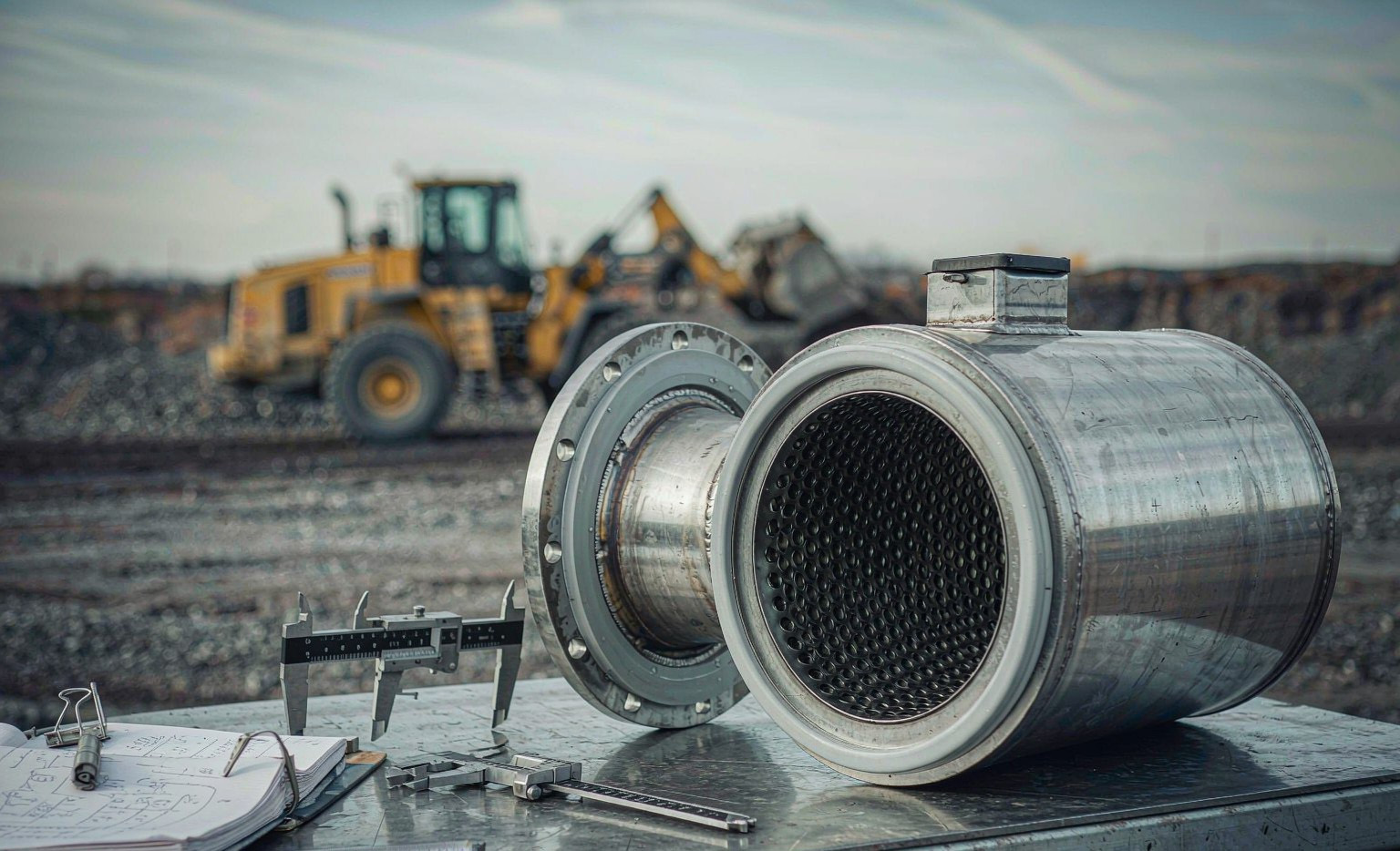
Most DPF problems on wheel loaders are sizing problems wearing a maintenance costume. The filter clogs because it was never big enough for the exhaust flow rate behind a 200 kW engine at rated load, or because the backpressure budget was spent on pipework before the filter got its share. The fix is a calculation, not a bigger cleaning invoice.
If you have ever typed how to choose dpf for wheel loader exhaust flow rate into a search bar and received a brochure, this article is the calculation that was missing. We take one machine — a 200 kW (268 hp), 6.7-litre wheel loader at 2,200 rpm — through five steps: exhaust mass flow, exhaust volume flow, filter volume, a space-velocity check and a pressure budget that ends at 200 mbar. Every number is rounded to working precision; swap in your own engine data sheet and the method holds.
Shenzhou sizes CDPF assemblies this way for off-road OEM customers including SANY, LOVOL and Weichai, so the values below are the same ones our own application engineers defend in design reviews.
1. How to Choose DPF for Wheel Loader Exhaust Flow Rate: Five Steps
Step 1 — Exhaust mass flow, from fuel burn. At 200 kW and a brake-specific fuel consumption of 210 g/kWh, the engine burns 42 kg of diesel per hour at rated load. With a full-load air–fuel ratio near 18:1, exhaust mass flow is fuel × 19 ≈ 800 kg/h, or about 0.22 kg/s. This two-line calculation is deliberately crude and deliberately first: the exhaust mass flow sets everything downstream.
Step 2 — Exhaust volume flow, at rated temperature. Rated exhaust temperature for a modern 6.7-litre off-road engine is about 450°C, where exhaust density is roughly 0.49 kg/m³. Divide and convert: 0.22 kg/s ÷ 0.49 ≈ 0.45 m³/s ≈ 1,600 m³/h at rated power. Idle flow is ten times lower, which is exactly why loaders kill undersized filters in low-load duty.
Step 3 — Filter volume, in litres. For wall-flow filters, rated-duty machines land between 30 and 60 cm³ of filter per rated horsepower — the dpf filter volume to engine power ratio cm3 per hp rule that fits on a workshop whiteboard. This loader carries rock and aggregate duty, so take the mid-high band: 268 hp × 55 ≈ 14,700 cm³, call it 15 litres. Cross-check against displacement: 15 L ÷ 6.7 L = 2.2×, inside the 1.5–2.5× band that wall-flow designs normally occupy.
Step 4 — Space-velocity check. Divide rated volume flow by filter volume: 1,600 m³/h ÷ 15 L ≈ 107,000 h⁻¹. That is marginally above the ~100,000 h⁻¹ ceiling we design wall-flow filters to at rated load. Two honest options: step up to 18 L (≈ 89,000 h⁻¹), or stay at 15 L and verify the soot-loaded pressure drop on a flow bench before committing. Skipping this step is how a filter that looks correct on paper whistles at full throttle.
Step 5 — Soot-loaded pressure check. Target soot accumulation of 5 g/L puts 75–90 g of soot in the filter at service point. For a 200 cpsi / 12 mil cordierite brick at these flows, soot-loaded pressure drop at rated lands around 60–100 mbar. If that number does not fit the budget in section 2, the filter is wrong, not the engine.
Run in order, those five steps are the whole answer to how to choose dpf for wheel loader exhaust flow rate — everything after them is verification.
✅ Bottom line: 15–18 litres of wall-flow filter behind a 200 kW loader engine, checked at ~100,000 h⁻¹ and 5 g/L soot, before anyone talks about price.
2. Maximum Allowable Exhaust Backpressure for DPF Sizing: Spending the 200 mbar
The first number to write down is the maximum allowable exhaust backpressure for dpf sizing — here, 200 mbar (20 kPa) at rated load, quoted from the engine maker's data sheet. It is an engine limit, not a filter property, and it varies: some makers allow 150 mbar, some 250. Get it in writing before you size anything, because every other number in the budget is spent out of it.
A defensible budget for this loader, measured at rated load, looks like this:
• Engine ceiling: 200 mbar. Fixed by the engine maker. Exceeding it means derate or torque cut, usually at the worst possible moment of the shift.
• Pipework and bends: ~30 mbar. Two 90-degree bends and three metres of pipe on a typical loader chassis. Layout is cheaper than filter volume — this is the first place to claw back margin.
• Muffler: 40–60 mbar depending on attenuation class. A silencer chosen for noise alone can quietly consume a third of the budget; check its flow-loss curve at 1,600 m³/h, not its catalogue minimum.
• Reserve for ageing: 40 mbar. Ash accumulates for the life of the filter and it all shows up as pressure. Budget it now or rediscover it at 5,000 hours.
• What remains for the DPF: 70–90 mbar soot-loaded, with a new-and-clean value under 30 mbar. Our section-1 number (60–100 mbar at 5 g/L) just fits — which is the point of doing the budget before the purchase order.
• Service trigger: 100–120 mbar, or twice the clean reading, whichever comes first. Above that, schedule cleaning; near 200 mbar, the machine schedules it for you.
In practice the second number your supplier should hand you is the maximum allowable exhaust backpressure for dpf sizing they designed to — if they cannot state it, they sized the can by catalogue, not by flow.
✅ Bottom line: A DPF that passes this budget when clean will still pass it at 5,000 hours. One sized by catalogue volume alone will not.
Frequently Asked Questions
Q: What dpf filter volume to engine power ratio cm3 per hp should I use?
A: For wall-flow filters, 30–60 cm³ per rated horsepower. Idle-heavy duty (lift trucks, generators, loaders that work a shovel half the shift) belongs at the top of the range because soot accumulates while exhaust flow — and passive regeneration — stay low. High-load duty can run toward the bottom.
Q: Cordierite or silicon carbide for a wheel loader?
A: Silicon carbide survives excursions to about 1,400°C during an uncontrolled regeneration; cordierite softens nearer 1,100–1,200°C. Cordierite is cheaper, lighter and fine where regeneration is well-managed. For loaders with long idle periods and unpredictable regen, the SiC premium is cheap insurance. Shenzhou supplies both substrates, matched to the duty cycle.
Q: Can you supply custom-sized DPF and DOC+DPF assemblies for wheel loaders?
A: Yes. Shenzhou builds custom CDPF and DOC+DPF assemblies for engines from 0.8 to 40 L as a China manufacturer with coating and canning in-house — OEM and ODM both, from one prototype to wholesale production volumes.
Send the Data Sheet, Get the Sizing Sheet
Send us your engine data sheet — rated power, displacement and rated exhaust flow, or just rated speed — and Shenzhou returns a sizing sheet within five working days: filter volume, cpsi and wall thickness, mat specification, and a predicted backpressure curve against your 200 mbar ceiling. Hefei Shenzhou Eco&Dream Catalytic Converters Inc quotes OEM and ODM builds from a drawing or a used sample. Start with the catalyst range, then check how the muffler selection fits the same backpressure budget.
Published: November 2026 | By Shenzhou Engineering Team
www.szexhaust.com
Hefei Shenzhou Eco&Dream Catalytic Converters Inc
About Author