Dual SIM 5G Router OEM / ODM Manufacturer Decision Guide: Three Buyer Stories That Show When Private Label Is Enough and When a Custom Design Pays Off
Companies approaching a dual SIM 5G router OEM / ODM manufacturer often arrive with a fixed idea: either "we just need our logo on it" or "we need something completely our own." In practice, the right answer depends less on ambition than on where the product's value really lies, how many units will be built, how quickly the product must launch, and who will carry the certification work.
Abstract frameworks only go so far, so this article works through three illustrative buyer stories, each ending in a different decision, and then draws out the factors that drove each outcome. It closes with the E-Lins starting points for each path.
OEM and ODM in Plain Terms
In an OEM arrangement, the buyer takes an existing, proven router and makes it its own through branding, packaging, labels, accessories, and default configuration. The hardware design stays as it is. In an ODM arrangement, the manufacturer changes or creates the design around the buyer's requirements, which may mean a different interface layout, a new enclosure, a board shaped for the buyer's product, or firmware behaviour that goes beyond default settings. Between the two lies a broad middle ground, and many successful programmes move along it over time.
Story One: The Surveillance Integrator
Consider an integrator that installs camera systems at construction sites, car parks and temporary events. It needs a dual SIM 5G router that powers two or three cameras, keeps video flowing if one operator fails, and can be managed centrally. Its customers see the integrator's brand on every cabinet and want a consistent look.
Nothing about the integrator's value lies inside the router's circuitry. Its value lies in design, installation, monitoring and service. A standard dual SIM 5G router with PoE Out, branded in the integrator's colours, shipped with its default VPN and management settings, does everything the business needs. Launching in weeks rather than months matters more than any hardware change.
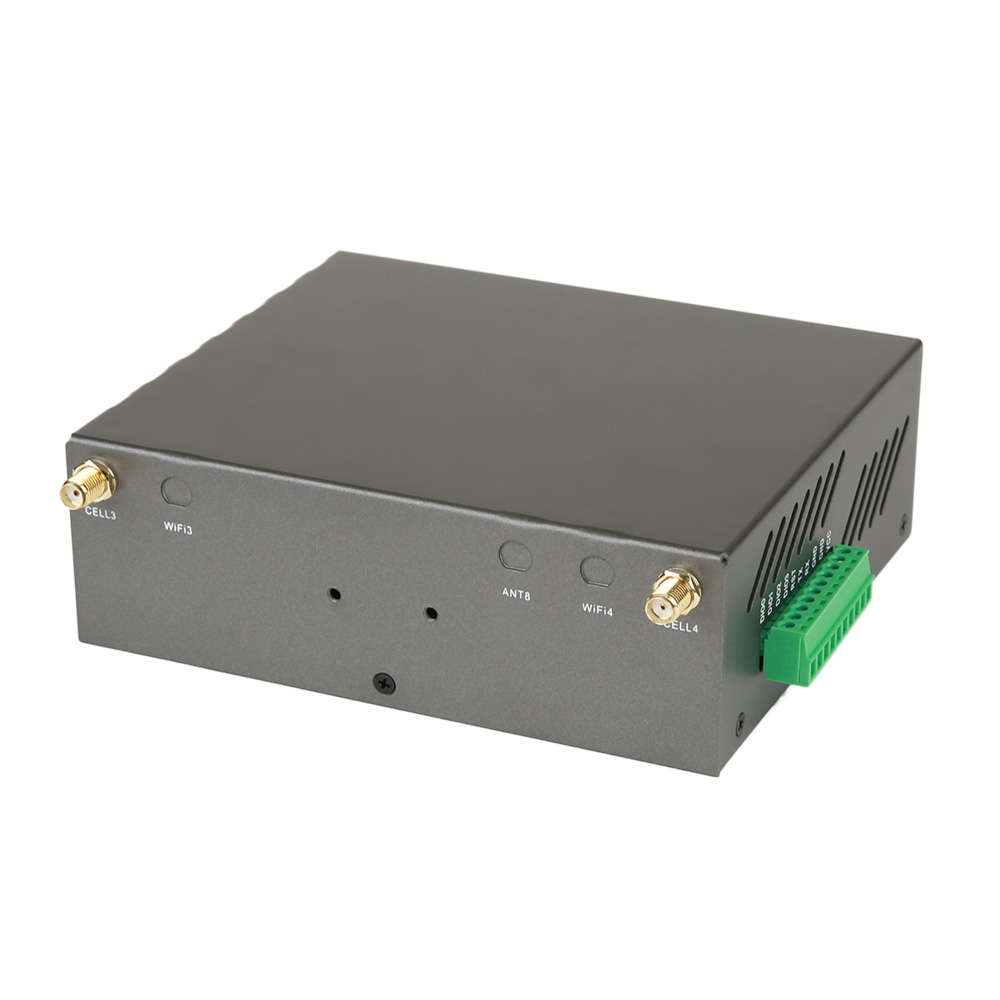
Decision: OEM. A router such as the E-Lins H900f, which combines 5G SA/NSA, dual SIM hot backup, Gigabit Ethernet, PoE In and Out, and four DI/DO for cabinet alarms, is a natural base, with labels, packaging, and firmware defaults customised.
Story Two: The Charging Equipment Maker
Now consider a manufacturer of charging stations for electric vehicles. It wants every charger to report status, receive configuration, and process payments over a reliable connection, and charging network operators expect every charger to stay online. The charger already has its own enclosure, controller, and power electronics, and there is no room for a separate router box with its own power supply.
Here the connectivity must become a component of the product. The board must fit the enclosure, take power from the charger's supply, sit near antennas mounted on the housing, and pass certification as part of the charger. Volumes are high, and the product will be sold for many years, which justifies engineering effort up front.
Decision: ODM. The starting point is an embedded board, such as the E-Lins H900f-B with 5G, dual SIM, five Gigabit Ethernet ports, and PoE in and out. If its layout does not suit the enclosure, the ODM route can adapt interface layout, hardware structure, and firmware behaviour to the charger's design.
Story Three: The Regional Service Provider
Finally, consider a regional connectivity provider that wants to sell a managed always-on service to retailers and small industrial sites. It is not yet sure which features its customers will value most, or how many units it will sell in the first two years.
Committing to a custom design before the market is understood would be a risk. Starting with a branded standard product lets the provider launch quickly, learn what customers ask for, and gather real data on volumes and failure modes. Once demand is clear, it can decide whether a tailored version, perhaps with a different port mix or enclosure, would sharpen its offer.
Decision: OEM first, ODM later. A staged path, starting with a branded H900f or, for moderate-data sites, the dual SIM H900frc RedCap router, keeps early risk low and leaves the door open to customisation once the service has proven itself.
What Drove Each Decision
|
Factor |
Integrator |
Charging maker |
Service provider |
|
Where the value lies |
Service and installation |
Integrated product |
Managed service |
|
Physical fit |
Separate cabinet unit is fine |
Must fit inside product |
Separate unit is fine |
|
Volume and life |
Moderate, ongoing |
High, long product life |
Uncertain at first |
|
Time to market |
Weeks |
Planned product cycle |
Fast launch, refine later |
|
Certification |
Router's own approvals |
Product-level approval |
Router's own approvals |
|
Outcome |
OEM |
ODM |
OEM, then possibly ODM |
Five Questions for Your Own Decision
Does any customer ever see or touch the router? If it is hidden inside your product, ODM becomes more likely.
Would a hardware change make your product better, or only different? Change hardware only when it creates real value.
Can volumes and product life carry the engineering and validation effort? Custom designs pay off over many units and many years.
How soon must you launch? A branded standard product reaches the market much faster.
Who will own certification? A product-level design brings product-level approvals, which take time and planning.
Commitments Beyond the Unit
Both routes carry responsibilities that are easy to underestimate. A brand owner is responsible for the product it places on the market, including, in the European Union, the cybersecurity requirements for internet-connected radio equipment that have applied since 1 August 2025. An ODM product also needs agreed validation, a plan for component changes during its life and clear ownership of firmware maintenance. Discuss these before the first design review, not after the first shipment.
E-Lins Starting Points for Each Path
For OEM programmes: standard dual SIM 5G routers such as the H900f and the H900frc RedCap router, and 5G modems such as the H900pf and H900uf that list dual SIM with eSIM. E-Lins customisation covers brand presentation, labels, packaging, private-label presentation and firmware behaviour.
For ODM programmes: embedded boards such as the H900f-B and H685f-B as starting points, with customisation that can involve hardware structure, interface layout, firmware behaviour and enclosure design. E-Lins describes its custom product work as running from early evaluation through product definition, testing and production preparation.
For both: firmware developed in-house with lifetime free upgrades, components rated from -35°C to +75°C, 15KV ESD protection and 1.5KV electromagnetic isolation, CE, FCC and UKCA certification, production in its own Shenzhen SMT factory under ISO 9001 and ISO 14001, and 7x24 remote technical support.
The Manufacturer
Shenzhen E-Lins Technology Co., Ltd. has worked in industrial wireless communication since its industrial roots in 1999 and has around 20 years of experience, including ODM and OEM manufacturing for global brands. When choosing between OEM and ODM with a dual SIM 5G router OEM / ODM manufacturer, start from where your product's value lies; the right path usually follows from that answer.
https://e-lins.com/
Shenzhen E-Lins Technology Co., Ltd.
About Author