High Purity SiC Powder: 7N Purity for PVT Crystal Growth
Addressing the Purity Challenge in PVT SiC Crystal Growth
For manufacturers engaged in physical vapor transport (PVT) silicon carbide crystal growth, the choice of source material directly determines the quality of the final single crystal. Traditional Acheson powder, long used as a raw material in this process, carries a well-documented limitation: it contains high nitrogen contamination and tends to graphitize during growth, which causes carbon inclusions in the resulting crystal. These defects translate into micropipes, structural inconsistencies, and reduced usable yield—problems that compound as wafer sizes and process temperatures increase.
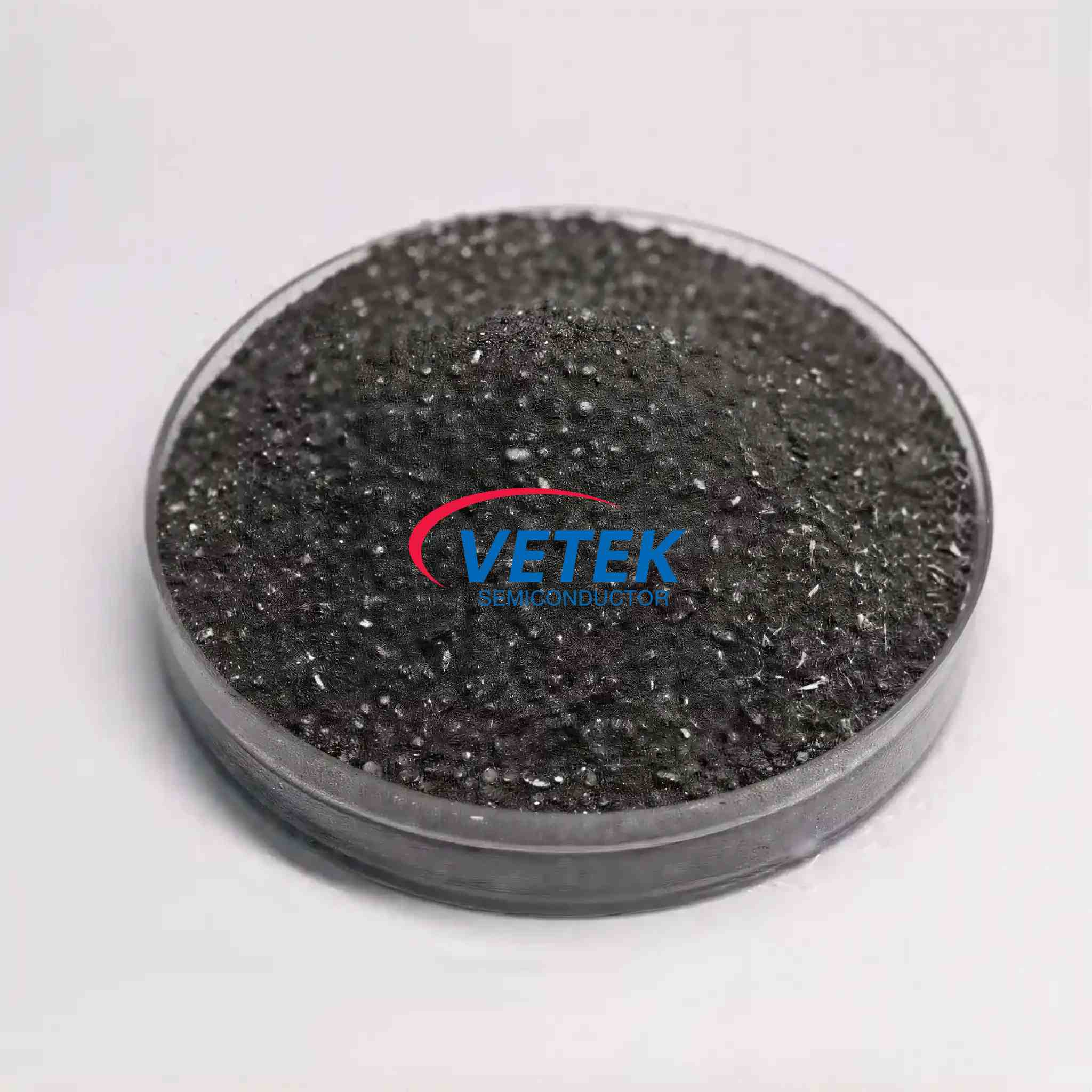
High Purity Silicon Carbide (SiC) Powder, offered as CVD SiC Raw Material within the product portfolio of Wuyi Tianyao New Material Technology Co., Ltd. (brand: VeTek Semiconductor), is positioned specifically as a source material for PVT SiC crystal growth. Rather than relying on conventional powder production routes, this material is engineered to minimize the exact failure modes—nitrogen contamination and late-stage graphitization—that limit crystal growers using standard inputs.
Core Technical Specifications of High Purity SiC Powder
The product's technical profile is built around two measurable characteristics: purity standard and grain morphology.
- High Purity Standard: The powder achieves 7N purity (≥ 99.99999%), with nitrogen concentration controlled to ≤ 5E15. This level of purity control is essential in PVT environments, where even trace nitrogen can migrate into the growing crystal lattice and disrupt its electrical and structural properties.
- Grain Morphology: The material is supplied as large-grain CVD polycrystalline blocks, with a controlled grain size range of 4–10mm. This is a deliberate departure from finer, less uniform Acheson-derived powders.
- Delivery Format: The product ships as high-purity granular material with total purity ≤ 5ppm, packaged for direct use in crystal growth crucibles.
These specifications are not incidental—they are the mechanism by which the product addresses the graphitization and contamination problems described above.
Yield Optimization Through Grain Morphology and Purity Control
The combination of 7N purity and the 4–10mm grain size produces a specific, quantifiable operational benefit: it allows the crucible to hold 1.5kg more raw material during a single growth run. This additional loading capacity is directly tied to preventing late-stage graphitization, since a larger, well-controlled charge of high-purity source material sustains stable sublimation and vapor transport further into the growth cycle before impurity-driven degradation can occur.
This causal relationship—purity and grain size enabling greater crucible loading, which in turn prevents late-stage graphitization—is the central value proposition of the product. It is a direct answer to the pain point that standard Acheson powder cannot resolve: contamination-driven carbon inclusions that emerge as the growth run progresses.
Manufacturing Backbone: Vertical Integration and R&D Investment
The reliability of a raw material like High Purity SiC Powder depends heavily on the manufacturing and quality infrastructure behind it. VeTek Semiconductor operates vertically integrated manufacturing capabilities, spanning prefabrication, hot pressing, purification, machining, and chemical vapor deposition, with dimensional handling capability exceeding 700mm. This integration supports consistent material quality control from raw input through final packaging.
Underpinning this capability is a dual R&D center platform—the Liufang R&D Center and the Yongjiang Laboratory Thermal Field Materials Innovation Center, the latter co-established with Yongjiang Laboratory. The company reports that R&D investment accounts for more than 30% of annual revenue, a figure that reflects sustained commitment to material science development in fields including silicon carbide, tantalum carbide, and pyrolytic carbon.
Quality verification for materials at this purity level requires advanced analytical instrumentation. The company's testing infrastructure includes Glow Discharge Mass Spectrometry (GDMS), Dynamic Secondary Ion Mass Spectrometry (D-SIMS), Scanning Electron Microscopy (SEM), Energy Dispersive Spectroscopy (EDS), and X-ray Diffraction (XRD)—tools well-suited to confirming trace-level impurity content such as the nitrogen concentration specification cited for this powder.
Quality Assurance and Industry Certifications
Beyond in-house testing, the company holds a set of third-party quality and environmental certifications relevant to buyers evaluating raw material suppliers for semiconductor applications. These include ISO 9001:2015 (Quality Management System), ISO 14001:2015 (Environmental Management System), ISO 45001:2018 (Occupational Health and Safety Management System), and CNAS Management System Certification (CNAS C035-M). The company's materials have also been screened for RoHS compliance, REACH SVHC requirements, and halogen-free status through SGS-certified reports.
These certifications provide an external, auditable layer of assurance around the manufacturing environment in which High Purity SiC Powder and related materials are produced—supplementing the internal purity specifications with documented process governance.
Market Validation and Industry Partnerships
VeTek Semiconductor's positioning in the third-generation semiconductor materials space is reinforced by its broader industry relationships. The company has received strategic capital investments from listed Chinese semiconductor companies, including Lion Microelectronics (605358) and Jiangfeng Electronic, signaling industry-level confidence in its material technology direction. Its business partners span the semiconductor and optoelectronics supply chain, including Sanan Optoelectronics, GlobalWafers, NAURA, NuFlare, and AMEC.
Within this same third-generation semiconductor domain, the company's experience extends to crystal growth furnace applications for clients such as Rohm Group Company (SiCrystal), where CVD TaC coated graphite components and pyrolytic carbon coatings were deployed to protect crystal growth furnaces in corrosive, high-temperature PVT environments—demonstrating operational familiarity with the exact PVT crystal growth conditions that High Purity SiC Powder is designed to serve as a source material.
Client feedback collected by the company describes consistent themes: reasonable pricing paired with high quality, smooth process execution, and clear, professional communication from sales staff. While these testimonials are not specific to the powder product, they reflect the general service standard applied across the company's material product lines.
Final Assessment
High Purity Silicon Carbide (SiC) Powder addresses a specific and well-defined problem in PVT SiC crystal growth: the nitrogen contamination and graphitization tendencies of conventional Acheson powder. Through its 7N purity specification, controlled 4–10mm grain size, and the resulting 1.5kg increase in crucible loading capacity, the product offers crystal growers a raw material engineered around measurable, verifiable performance criteria rather than general claims. Supported by vertically integrated manufacturing, a dual R&D center structure, documented quality certifications, and demonstrated experience within the third-generation semiconductor supply chain, the product represents a raw material choice grounded in traceable technical specifications for buyers evaluating PVT SiC crystal growth inputs.
https://www.veteksemicon.com/
Wuyi Tianyao New Material Technology Co., LTD
About Author