How to Calculate Total Load for Router and ONT Backup Power
Understanding the Real Power Demand Behind Router and ONT Backup
Network equipment such as routers, modems, and ONTs often reboot or lose service during short power outages, voltage drops, or unstable grid conditions. For telecom operators, Internet Service Providers (ISPs), broadband network companies, fiber network operators, and system integrators, this interruption translates directly into service complaints and repeat support calls. The core challenge is not simply "adding a battery" to a device—it is correctly calculating the total load that a backup system must support before any hardware is selected.
Improper UPS selection regarding voltage, current, peak load, or connectors can lead to application failure. This is why a systematic approach to load calculation is a prerequisite for any reliable DC backup deployment, particularly when a single backup unit is expected to support both a router and an ONT at the same time.
Why Total Load Calculation Matters for Reliable Backup
A Mini UPS or DC backup solution is only as reliable as the accuracy of the load assessment behind it. Evaluation of solutions based on real device voltage, working current, peak/startup behavior, and installation environment is the differentiated advantage that separates a functioning backup deployment from one that fails during the first extended outage. Technical confirmation and connector/cable matching further reduce selection errors that are common when project teams rely on generic assumptions rather than actual device specifications.
Key Variables in Calculating Combined Load
Four variables must be defined clearly before selecting a backup unit for combined router and ONT protection:
Operating voltage: Most residential and small-business routers, ONTs, ONUs, modems, gateways, and CPE devices operate on 12V DC, though some higher-voltage wireless CPE and radio bridge equipment require 24V or 48V inputs.
Working current: This is the steady-state current a device draws once powered on. It is different from peak or startup current, which is typically higher for a short duration.
Peak/startup behavior: Devices frequently draw a short burst of current above their steady-state rating during boot-up. A backup unit sized only for working current, without margin for this peak, can fail exactly at the moment it is needed most.
Connector and cable compatibility: Even when voltage and current are correctly matched, an incompatible connector type (such as DC5521 versus DC5525) can prevent proper installation or cause unreliable contact.
Combined System Load Example
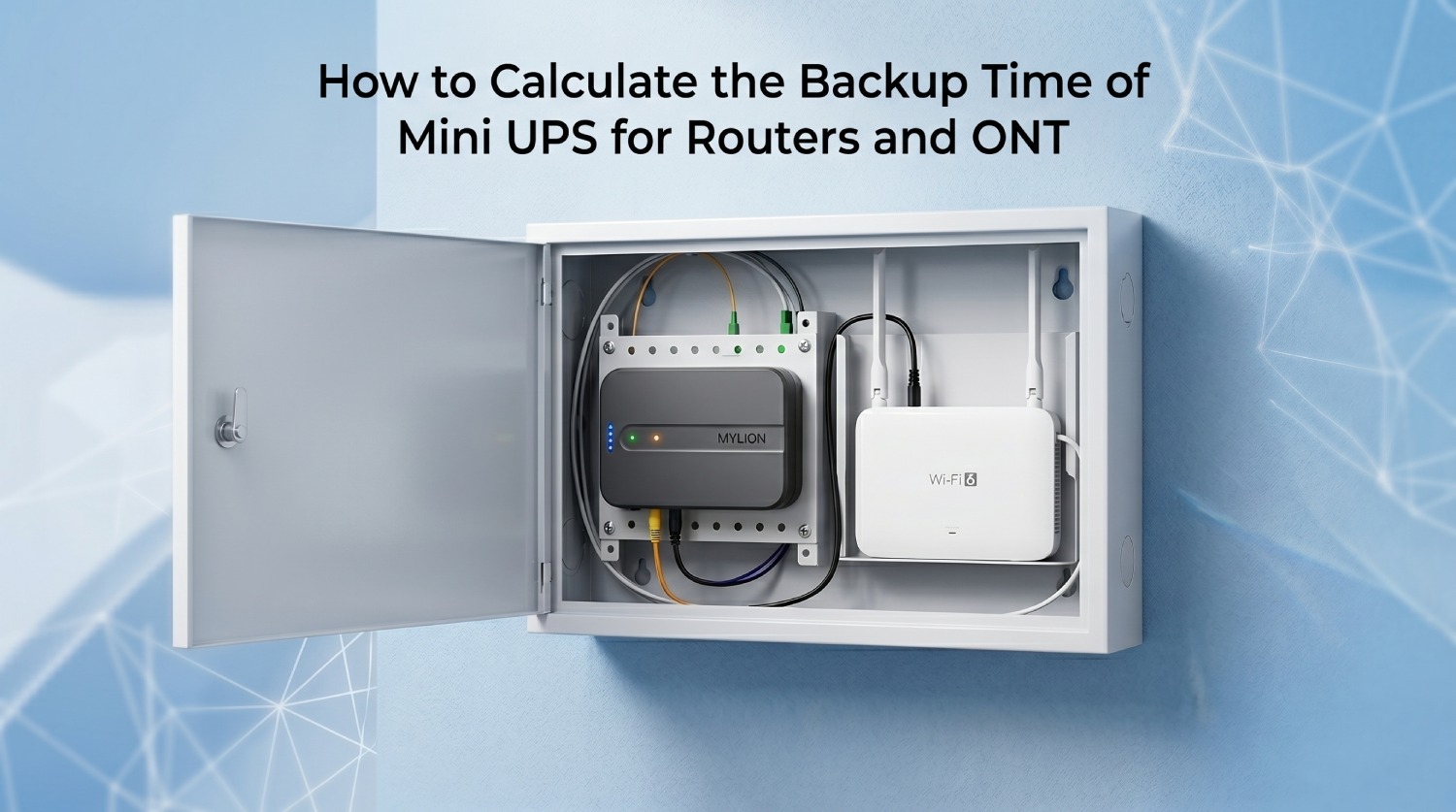
When a router and an ONT must be backed up from the same unit, the total system load is the sum of each device's working current at the shared voltage, with the backup unit's rated output required to exceed that combined figure, not merely equal it. For example, a dual-output AC-input unit rated for two independent 12V DC ports at 2A each, with a 24W total system limit, is structured specifically for installations where an ONT and a router are powered from a single AC wall outlet rather than requiring two separate DC adapters. In this configuration, the 24W ceiling represents the limit for both devices combined, not per port, so the actual working current of the ONT plus the router must be verified against that limit before deployment.
Similarly, multi-output configurations that combine a 12V DC port with USB-A and USB-C outputs are built around a defined system limit (such as 18W maximum total output) that applies across all ports simultaneously. This means a device connected to the USB-C port and a router connected to the 12V port share the same power ceiling, and project teams must confirm that the sum of both loads stays within that limit.
Matching Calculated Load to a Backup Solution
Once the combined load is known, the appropriate product category becomes clear. Standard 12V Mini UPS units supporting 2.5A continuous current in a compact form factor are suited to entry-level to mainstream broadband backup where router or ONT reboots from short outages are the primary concern. Where the combined load or an individual device exceeds standard thresholds—for example, high-load CPE or gateways drawing more than 2.5A—12V high-power series units offering 4A continuous output (60W total) become the relevant category. When extended outage duration is the priority rather than peak current, long-runtime series with higher battery energy, such as 75.6Wh configurations, address residential or remote-area power interruptions without changing the output current profile.
For installations requiring both high output current and long backup duration simultaneously, high-power long-runtime series supporting 60W output alongside 75.6Wh capacity are built specifically for professional gateways requiring high peak current and long backup time. Development-stage directions, including a USB-C PD Mini UPS under project evaluation for WiFi 6/7 devices requiring Power Delivery, and a 24V/48V telecom backup direction still under development for higher-voltage wireless CPE and radio bridge equipment, indicate ongoing expansion into higher-power and higher-voltage combined-load scenarios.
Practical Steps for Project Teams
A structured process reduces the risk of mismatched backup power:
- Requirement analysis: document the actual voltage, working current, and peak current of both the router and the ONT before reviewing any product specification sheet.
- Model matching: compare the documented combined load against the rated continuous and maximum output of candidate Mini UPS models.
- Connector/cable matching: confirm interface types, such as DC5521 input or DC5525 output, align with the target devices to avoid installation failures.
- Sample testing support: validate the selected model under real installation conditions before committing to volume deployment.
- Documentation coordination: for lithium battery-based solutions, transport documentation and model-specific compliance requirements, including UN38.3 and MSDS certifications where applicable, must be confirmed alongside the technical fit.
A Technical Partner for Combined Load Deployments
Shanghai Mylion New Energy Co., Ltd., operating under the brand MYLION, positions itself as a global B2B provider of Mini UPS products, DC backup power solutions, and project support for telecom, ISP, broadband, and security applications. With 13+ years of experience in lithium battery technology and 10+ years of experience in Mini UPS development, MYLION's approach centers on evaluating real device voltage, working current, and peak/startup behavior rather than relying on generic power ratings.
The company's product matrix—spanning 12V standard, long-runtime, high-power, high-power long-runtime, multi-output, and AC-input dual-output series—covers a range of combined router-and-ONT load scenarios, supported by requirement analysis, model matching, sample testing support, connector/cable matching, private labeling, and documentation coordination for OEM/ODM and project customers. For telecom operators, ISPs, broadband network companies, fiber network operators, and system integrators seeking to calculate and address total backup load accurately, this evaluation-first methodology, detailed further at www.myliontech.com, supports more reliable DC backup deployment while reducing avoidable selection risks.
www.myliontech.com
Shanghai Mylion New Energy Co.,Ltd.
About Author