
Double Drum Tire Building Machine Boosts Precision in Tire Production
A tire building machine plays a crucial role in the production of high-quality tires, especially in factories pursuing higher accuracy, reduced material waste, and consistent structural integrity. With the growing demand for automated tire assembly, this equipment has become indispensable for ensuring uniform carcass formation, stable building pressure, and reliable material handling. In this blog post, SONIWELL will share the role of double drum tire building machine in tire production, including aspects such as structural integrity, applications, etc.
How Double Drum Tire Building Machine Shapes Tire Production
A double drum tire building machine is designed to assemble multiple tire components—carcass layers, tread, sidewall, inner liner alternatives, and bead systems—into a precise cylindrical structure. It works through two coordinated drums: one for building the carcass and another for shaping or expanding the tire into its near-final form.
This configuration enhances stability during the tire construction process, reduces deformation, and ensures each layer is applied with controlled tension. When paired with servo-driven conveyors, automated measurement systems, and intelligent detection modules, the machine significantly improves both product uniformity and production efficiency.
Structural Integrity of Double Drum Tire Building Machines with Welded Frames
A standout feature is the integral welded mainframe, which provides rigid mechanical support. This heavy-duty foundation minimizes vibration and ensures long service life under continuous industrial loads.
A stable frame translates into:
-
Improved dimensional accuracy across all tire batches
-
Reduced mechanical misalignment during drum rotation
-
Higher repeatability when applying delicate carcass layers
The welded structure also enhances compatibility with automated subsystems, such as servo cutters, ultrasonic trimming tools, and vision-based detection units.
Spring-Reversed Tire Drum Technology in Double Drum Tire Building Systems
A modern spring-reversed tire drum allows smooth expansion and contraction during carcass forming. Equipped with vacuum suction ports, it is particularly suitable for tires without an inner liner, ensuring that each material layer adheres correctly to the drum surface.
Key benefits include:
-
Controlled clamping force for uniform tension
-
Reduced risk of material slippage
-
Reliable support for lightweight or liner-less tire designs
Vacuum functions stabilize the carcass during rotation and prepare the assembly for subsequent bead insertion and shaping stages.
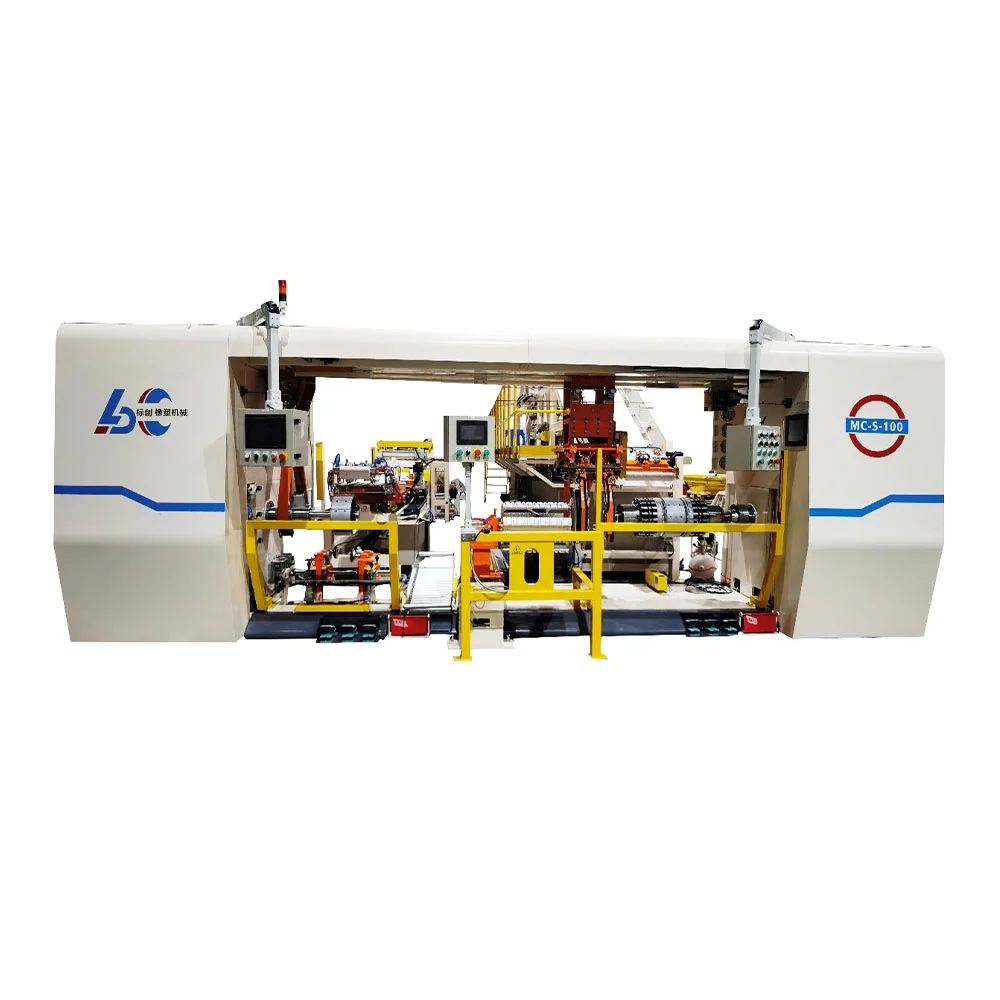
Two-Stage Servo Feeding in Double Drum Tire Building Equipment
A major upgrade in advanced machines is the integration of two-stage servo conveyor feeding systems. These systems drastically improve the accuracy of fixed-length material delivery.
Their precise control brings notable advantages:
-
Ensures consistent strip width and layer overlap
-
Minimizes deviations caused by manual measurement
-
Reduces scrap material and enhances repeatability
Servo feeding also supports high-speed production lines while maintaining tight tolerances, enabling manufacturers to handle diverse tire specifications with minimal adjustments.
Automated Cutting Solutions for Double Drum Tire Building Machine Operations
To maintain material consistency, modern machines feature automatic fixed-length measurement and automatic cutting for each layer—such as ply fabric, bead wrap materials, and belt cushion components.
This automated cutting system offers:
-
Accurate length matching regardless of operator skill level
-
Stable performance during rapid cyclic operations
-
Reduced human error in multilayer assembly
For tread cutting, an ultrasonic cutter is commonly used. This tool generates a clean and precise cut, and its heated cutting edges effectively shape both the head and tail of the tread strip, ensuring smooth splicing and extended tire uniformity.
Material Joint Detection in Double Drum Tire Building Processes
High-precision tire building relies on strict control of material joints. A sophisticated carcass layer joint detection system evaluates alignment, angles, and overlaps in real time.
It identifies abnormalities such as:
-
Flash seams
-
Misaligned angles
-
Overlap mismatch (big head/small head)
-
Missing paste or incomplete bonding
Through sensors and imaging technologies, the machine prevents defective carcass layers from advancing to the next stage, improving overall quality and minimizing rework.
Integration of Automated Control in Double Drum Tire Building Technology
The latest double drum tire building machine technology incorporates closed-loop control through sensors, servo actuators, and PLC platforms. This digital integration supports real-time monitoring of parameters such as tension, drum speed, and feeding accuracy.
Automation leads to:
-
Predictable production cycles
-
Data-driven maintenance scheduling
-
Seamless transitions between tire models
This level of control enhances process stability and aligns with Industry 4.0 expectations.
Manufacturing Efficiency Gained from Double Drum Tire Building Machines
A well-engineered double drum tire building equipment setup improves factory performance and shortens production cycles. The combination of automatic detection, servo feeding, fixed-length cutting, and vacuum-assisted drum support leads to:
-
Faster tire assembly with reduced manual intervention
-
Consistent quality that meets global manufacturing standards
-
Lower operational costs due to reduced waste and fewer defects
The double drum layout also allows for balanced shaping and carcass building, contributing to higher productivity in medium and large tire plants.
Applications of Double Drum Tire Building Machines Across Industries
These machines are widely used in:
-
Passenger car tire production
-
Light truck and SUV tire assembly
-
Specialized tires requiring multilayered construction
-
Factories producing both radial and bias tires
Their strong adaptability allows manufacturers to switch specifications quickly while maintaining structural consistency.
Considerations When Selecting a Double Drum Tire Building Machine
Companies choosing this equipment should evaluate factors such as:
-
Frame rigidity and long-term stability
-
Precision of servo-driven feeding and cutting
-
Joint detection accuracy
-
Drum expansion smoothness
-
Customization options for specific tire categories
A well-configured machine ensures compatibility with future automation upgrades and advanced material technologies.
Future Trends in Double Drum Tire Building Machine Development
As tire manufacturers increasingly adopt smart factories and digital production, next-generation machines will focus on:
-
Higher automation with AI-based defect prediction
-
Integration with MES and cloud-based monitoring
-
Improved ultrasonic cutting efficiency
-
Drum designs optimized for new eco-friendly materials
These enhancements will help manufacturers meet stricter quality requirements while reducing overall resource consumption.
Conclusion
A double drum tire building machine is fundamental to producing high-precision, structurally consistent tires. With an integral welded mainframe, spring-reversed drum, servo-driven feeding, ultrasonic cutting, and intelligent joint detection, the equipment supports efficient, accurate, and repeatable tire assembly. Its engineered design aligns with modern industrial expectations, ensuring manufacturers achieve long-term reliability and high production quality across a wide range of tire types.
www.soniwellgroup.com
SONIWELL
About Author