How Does a Surface Water Filtration System Handle Seasonal Algae Blooms?
Seasonal algae blooms are a common challenge for water treatment facilities that rely on rivers, lakes, reservoirs, and other natural water sources. When water temperature, sunlight, nutrient levels, and other environmental conditions become favorable, algae can multiply rapidly. The resulting increase in algal cells can change raw water quality within a relatively short period, creating additional pressure on downstream treatment processes.
For facilities using natural water as a source, the challenge is not simply removing algae from the water. A filtration system must also continue operating when algae concentrations fluctuate significantly. Large amounts of algae can accumulate on filter media, increase filtration resistance, shorten cleaning intervals, and affect treatment capacity if the equipment is not properly designed for variable raw water conditions.
This is why modern surface water filtration systems need to combine effective particle interception with anti-clogging features, automatic backwashing, pretreatment, and flexible operating controls. When these elements work together, the system can better manage seasonal algae blooms while maintaining stable filtration performance.
Why Do Seasonal Algae Blooms Create Filtration Challenges?
Algae are naturally present in many surface water sources. Under normal conditions, their concentration may be relatively low and manageable. However, certain environmental conditions can accelerate their growth.
Warm temperatures, sufficient sunlight, and elevated nutrient concentrations can create favorable conditions for algae reproduction. During these periods, a lake or reservoir can experience a significant increase in algal biomass.
From a water treatment perspective, this creates several problems.
First, the number of particles entering the filtration process increases. Second, algae cells can accumulate on the filtration surface and form a biological layer. Third, algae may occur together with suspended solids, organic matter, and colloidal particles, creating a more complex contaminant mixture.
As a result, a surface water filtration system designed only for average water quality may struggle during a severe seasonal bloom.
The filtration process therefore needs to account for both normal operating conditions and temporary increases in contaminant loading.
How Does a Surface Water Filtration System Remove Algae?
The basic mechanism is physical interception.
Depending on the filtration technology and filtration precision, filter media can retain algae cells and other suspended materials while allowing treated water to pass through. Cloth media filtration is one approach used for this purpose because high-precision fiber filter cloths can provide a physical barrier for suspended particles.
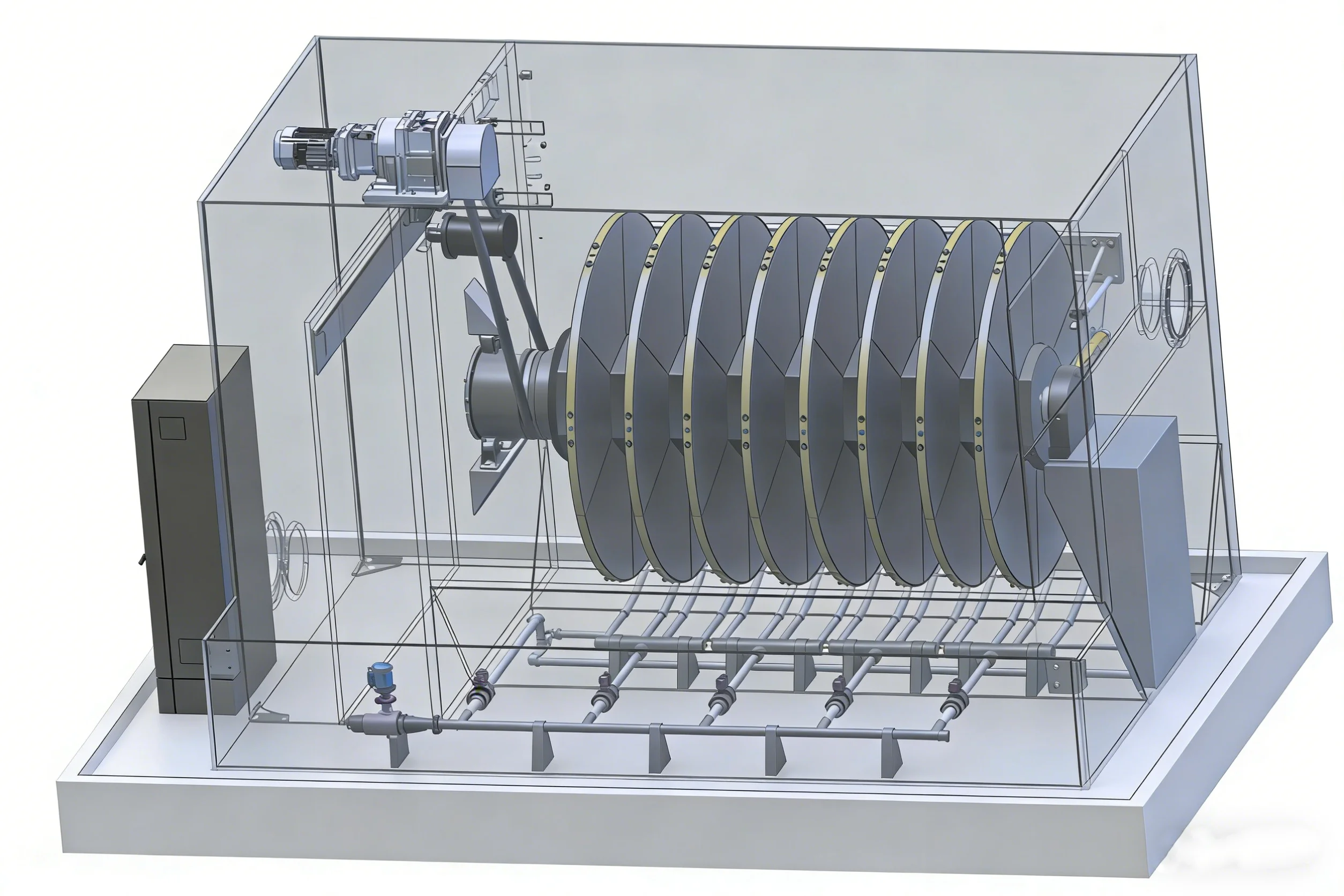
In a cloth-based surface water filtration system, raw water comes into contact with the filtration surface. Algae, suspended solids, plankton, and other particles are retained, while filtered water passes through the media and enters the collection system.
The effectiveness of this process depends on factors such as particle characteristics, filter media properties, hydraulic conditions, and the concentration of algae in the incoming water.
It is also important to distinguish between removing intact algal cells and removing dissolved substances produced by algae. Physical filtration is primarily intended to remove particulate matter and intact cells. If dissolved algal toxins or other dissolved organic compounds are present, additional treatment technologies may be required.
Why Is Filtration Precision Important During an Algae Bloom?
Filtration precision is an important consideration when treating algae-rich surface water.
Algae vary in size and physical characteristics, and surface water may contain different species at different times of the year. A filtration system therefore needs to be selected according to the target particles and required downstream water quality.
If the filtration media is too coarse, some smaller particles may pass through. If filtration is unnecessarily fine, however, the filtration surface may load more rapidly, particularly when algae concentrations are high.
This creates a practical balance between particle removal and filtration continuity.
For many surface water treatment systems, the objective is not simply to use the finest possible filter media. Instead, the filtration level should be matched to the raw water characteristics, treatment objectives, flow rate, and cleaning strategy.
A properly selected filter media can capture the target algae and suspended solids without creating unnecessary operational resistance.
How Does Anti-Clogging Design Help During Algae Blooms?
One of the biggest operational concerns during a seasonal algae bloom is rapid filter loading.
As algae cells accumulate on a filtration surface, they can reduce the available area for water to pass through. When algae are mixed with silt, suspended solids, organic matter, or colloids, the accumulated layer can become even more difficult to manage.
This is why anti-clogging design is an important feature of surface water filtration equipment.
An anti-clogging design does not mean that the filter will never become loaded. Instead, it helps control the accumulation of contaminants and allows the filtration surface to be cleaned before excessive buildup affects operation.
Several features can contribute to this process:
-
Appropriate filter cloth structure
-
Sufficient filtration area
-
Automatic backwashing
-
Water-level monitoring
-
Turbidity monitoring
-
Adjustable cleaning intervals
-
Pretreatment screening
-
Dynamic filtration control
Together, these features help the system respond to changing algae concentrations instead of operating under a fixed set of conditions throughout the year.
How Does Automatic Backwashing Manage Algae Accumulation?
Backwashing is one of the most important mechanisms for controlling algae buildup.
During normal filtration, algae and other suspended particles accumulate on the filter media. As the loading level increases, the system can detect a change in water level, pressure difference, or another predefined operating parameter.
The cleaning cycle can then be activated automatically.
For cloth-based filtration systems, backwashing removes accumulated contaminants from the fiber filter cloth and restores filtration capacity. The cleaning process can be repeated at intervals determined by actual operating conditions.
This is particularly useful during algae blooms because the required backwash frequency may change considerably.
Under normal conditions, a filter may operate for a relatively long period before cleaning is required. During an algae bloom, however, the filter may load more quickly and require more frequent cleaning.
An automatic backwashing system allows the equipment to respond to this change without requiring operators to manually initiate every cleaning cycle.
Can the Backwash Interval Change During an Algae Bloom?
Yes. In a well-designed system, the backwash interval should not necessarily remain fixed throughout the year.
Seasonal algae concentrations can vary significantly. A filtration system that operates efficiently during the winter may require a different cleaning strategy during the warmer months when algae growth increases.
For example, if the algae concentration in raw water rises, contaminants may accumulate on the filter cloth more quickly. The system can respond by initiating cleaning at a shorter interval or according to a predetermined water-level or filtration condition.
When algae concentrations decline, the cleaning interval can be adjusted accordingly.
This type of dynamic adjustment can help avoid two opposite problems.
If cleaning occurs too infrequently, algae may accumulate excessively and restrict water flow.
If cleaning occurs too frequently, unnecessary backwash water and energy may be consumed.
The goal is therefore to achieve a practical balance between filter cleanliness, water recovery, energy consumption, and continuous treatment.
Why Is Pretreatment Important for Algae-Rich Surface Water?
Algae are not the only contaminants entering a natural water filtration system.
Rivers, lakes, and reservoirs can also contain leaves, branches, aquatic plants, coarse suspended materials, and other debris. These materials can interfere with the main filtration stage if they are not removed beforehand.
For this reason, pretreatment can play an important role in protecting the primary filter.
A coarse screen or rotating screening device can intercept larger debris before water reaches the finer filtration stage. This reduces the amount of material that the main filter needs to handle and can help maintain more stable operation.
Pretreatment is especially useful during periods of heavy rainfall or seasonal changes when natural water sources may carry increased amounts of organic debris.
In other words, controlling clogging during an algae bloom is not only about cleaning the filter more frequently. It is also about preventing unnecessary contaminants from reaching the filtration surface in the first place.
How Does the System Handle Sudden Changes in Algae Concentration?
Seasonal algae blooms do not always develop gradually from the perspective of a treatment plant.
Weather conditions, nutrient availability, water temperature, and water circulation can cause significant changes in algae concentration. A facility may therefore experience periods in which raw water quality changes much faster than expected.
This is where monitoring and automatic control become valuable.
Water-level sensors, turbidity sensors, and other monitoring components can provide information about the current filtration condition. Based on these signals, the filtration equipment can adjust operating parameters or initiate cleaning.
For example, an increasing water level above the filter can indicate that the filtration resistance is rising because contaminants are accumulating on the media.
Rather than waiting until the filtration process becomes severely restricted, the system can begin a cleaning cycle earlier.
This proactive approach can help maintain more consistent filtration capacity.
What Happens When Algae Are Mixed With Suspended Solids?
In real surface water applications, algae rarely occur in isolation.
A reservoir experiencing an algae bloom may also contain silt, clay particles, organic matter, and plankton. A river may carry additional sediment following rainfall.
When different contaminants accumulate together, they can form a more complex layer on the filter surface.
For example, fine sediment can become trapped together with algal cells, while organic materials can contribute to the formation of a denser deposit.
This makes cleaning performance especially important.
A surface water filtration system should therefore be evaluated based on the actual composition of the raw water rather than algae concentration alone.
Water quality testing before equipment selection can help determine the expected contaminant loading and the appropriate combination of pretreatment, filtration precision, filtration area, and cleaning frequency.
How Does Jinhua's Surface Water Filtration System Address Seasonal Algae?
Jinhua's surface water filtration system is designed for natural water bodies such as rivers, lakes, and reservoirs, where water quality can fluctuate throughout the year.
The system uses high-precision fiber filter cloths to physically intercept algae, suspended solids, colloids, and plankton. By reducing turbidity and pollutant loads, the filtration process can provide improved raw water for downstream applications such as drinking water pretreatment, landscape water improvement, and agricultural irrigation.
The system also incorporates design considerations for conditions such as seasonal algae growth and fluctuating suspended-solid concentrations. Pretreatment screening helps intercept larger debris, while automatic backwashing helps remove accumulated contaminants from the filter cloth.
Dynamic operation is particularly useful because the filtration requirements of a natural water source are rarely identical throughout the year.
Instead of treating seasonal algae blooms as an entirely separate filtration process, the system can adjust its cleaning and operating strategy according to changing raw water conditions.
Does Filtration Alone Solve Every Problem Caused by Algae?
Not necessarily.
This distinction is important when designing surface water treatment systems.
Physical filtration can remove intact algae cells and other suspended particles. However, algae-related water quality problems may involve more than visible cells.
Some algae can produce compounds that remain dissolved in water. Dissolved substances behave differently from suspended particles and may not be removed simply by passing water through a cloth filter.
Depending on the intended application and raw water quality, additional treatment stages may therefore be required.
For drinking water pretreatment, for example, filtration may serve as one part of a broader treatment train. Other processes can subsequently address contaminants that are not effectively removed through physical particle interception.
The appropriate solution depends on the characteristics of the raw water and the final water quality requirements.
How Can Operators Prepare for Seasonal Algae Blooms?
Preparation should ideally begin before algae concentrations reach their seasonal peak.
Historical water quality data can help operators identify periods when algae concentrations typically increase. Monitoring water temperature, turbidity, algae indicators, and other relevant parameters can provide additional information about changing conditions.
Several practical measures can be considered.
Inspect the Filtration Equipment
Before the algae season begins, inspect filter cloths, backwash nozzles, motors, rotating components, valves, sensors, and other important parts.
A cleaning system that is not functioning properly can become a major operational problem when algae loading suddenly increases.
Check Pretreatment Equipment
Screens and other pretreatment components should also be inspected and cleaned.
If a coarse screen becomes blocked by leaves or aquatic vegetation, the problem may affect the entire filtration process.
Review Backwash Settings
The normal backwash strategy may need to be adjusted for seasonal conditions.
Historical operating data can help determine whether shorter cleaning intervals are appropriate during periods of high algae concentration.
Monitor Raw Water More Closely
Regular monitoring allows operators to identify changes before they become severe.
Increased turbidity or visible algae accumulation may indicate that the filtration process needs to respond to a changing contaminant load.
What Should Buyers Consider When Selecting a Surface Water Filtration System?
For projects where seasonal algae blooms are expected, buyers should look beyond the nominal treatment capacity of the equipment.
Several questions are worth considering.
What Is the Typical and Peak Algae Concentration?
Average raw water quality does not always represent the conditions that the system must handle.
Peak seasonal conditions should be considered during equipment sizing and filtration design.
How Much Does Turbidity Fluctuate?
Algae may occur together with suspended solids, particularly after rainfall. Understanding turbidity fluctuations can help determine the required filtration and pretreatment configuration.
How Is the Filter Cleaned?
Ask how the filter media is cleaned and whether the cleaning process can operate automatically.
Can the System Adjust to Changing Conditions?
Dynamic adjustment can be valuable when raw water characteristics vary throughout the year.
How Much Water Is Used for Backwashing?
Backwash water consumption can influence overall water recovery and operating costs. A suitable system should provide effective cleaning without unnecessary water consumption.
Is the Filter Media Suitable for Algae Removal?
The filtration media should be selected according to the target particles, filtration precision, expected loading, and cleaning requirements.
These factors can help buyers select surface water filtration equipment that is better suited to real operating conditions rather than simply choosing equipment based on a single capacity specification.
Conclusion
Seasonal algae blooms can place additional pressure on natural water treatment processes, particularly when algae concentrations increase rapidly in rivers, lakes, or reservoirs. The challenge involves more than algae removal itself. The filtration system must also control the accumulation of algal cells and other suspended materials on the filter media.
Surface water filtration systems designed with appropriate filtration precision, anti-clogging features, automatic backwashing, pretreatment, and dynamic adjustment can better respond to these changing conditions. For facilities dealing with seasonal algae, the key is to maintain stable filtration while adapting to changes in raw water quality.
With its surface water filtration system designed for rivers, lakes, and reservoirs, Jinhua focuses on practical filtration solutions that address algae, suspended solids, and other natural water impurities. By combining high-precision fiber filter cloths with automated backwashing and anti-clogging design, Jinhua provides filtration equipment suited to applications where water quality can vary significantly throughout the year.
www.jinhuacn.com
jinhua
About Author