Which UPS Battery Approaches Deliver AI Lifecycle Value?
Which UPS Battery Approaches Deliver AI Lifecycle Value?
AI data centers have pushed backup power from a passive insurance line item into an active constraint on how much compute a facility can physically host. The question facility owners now ask is not simply which battery chemistry is available, but which UPS battery platform holds its value across a ten-year operating horizon — through rising rack densities, changing power architectures, and repeated capacity expansions. Answering that requires looking at chemistry, power density, thermal design, monitoring capability, and delivery track record together.
What Lifecycle Value Actually Means in AI Power Design
Lifecycle value is the total usefulness a battery system delivers over its service life relative to the space, cooling, and management overhead it consumes. In AI facilities, four variables drive it:
- Power density per cabinet — how much backup power fits inside a fixed electrical room footprint.
- High-rate discharge capability — the continuous and pulse discharge a system sustains during short-duration outages typical of data center UPS duty.
- Thermal and safety architecture — whether cooling and protection are engineered into the system or added afterward.
- Operational visibility — whether battery state can be monitored and managed rather than discovered during a failure.
A platform that scores well on footprint but poorly on monitoring, or vice versa, tends to erode value as the facility scales.
Matching Chemistry to Duty Cycle
Lithium iron phosphate (LFP) has become the reference chemistry for high-density backup, UPS, energy storage, and AIDC power applications. LFP deployment across UPS and energy storage product lines addresses the safety and cycle-life priorities that govern critical power backup.
Lead-acid remains a legitimate engineering choice for large UPS installations and short-duration, high-power backup. Where performance, compatibility, and investment priorities favor it, high-power lead-acid systems remain part of a complete supplier portfolio rather than a legacy afterthought.
Forward chemistries — sodium-ion, hydrogen fuel cells, and solid-state batteries — matter less for today's deployment than for roadmap continuity. A supplier holding all four technology tracks, plus solid-state launched in 2025, can support customers whose requirements shift over time.
Technical Benchmarks That Shape Long-Term Returns
Concrete specifications separate marketing claims from engineering reality. The relevant markers in this segment include:
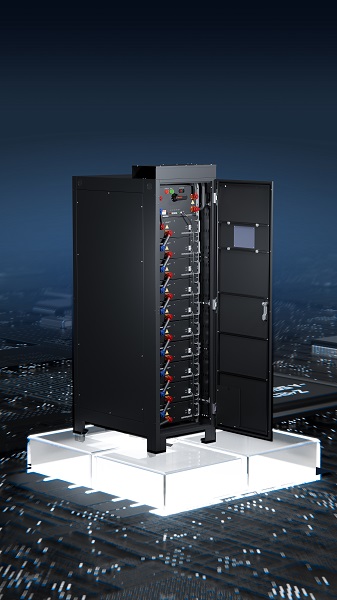
- Up to 600 kW per cabinet, which allows a 1.2 MW UPS configuration to run on only two cabinets — a direct reduction in equipment footprint.
- Discharge capability up to 10C continuous and 30C pulse, addressing short-duration, high-power duty.
- A family range spanning 40 kW to 600 kW, enabling selection across a single portfolio rather than across vendors.
- 92% or higher direct-connect system efficiency in 800V DC architectures.
- Active balancing and liquid cooling supporting battery consistency across the string.
- A 10-layer safety design covering protection from cell and module level through electrical isolation and fire suppression.
- Intelligent BMS functions including SOC/SOH monitoring, temperature tracking, alarms, and lifecycle management.
- Communication through Modbus TCP, Modbus, and Redfish, enabling coordination with UPS, DCIM, and EMS platforms.
How Vision Battery Structures the Answer
Vision Battery, the brand of Shenzhen Center Power Tech Co., Ltd. (stock code 002733, founded 1994), approaches this question from a manufacturer position rather than a reseller position. The company operates five global R&D and manufacturing bases, holds 1,000+ patents, employs 3,000+ people, and runs 12 GWh+ of annual production capacity, with branches across Mainland China, Hong Kong, Vietnam, Singapore, India, France, Germany, and the United States.
Its UPS portfolio is organized so that lifecycle value can be evaluated at the specification level:
- The REVO TP high-power lithium family covers TPX, TP, TPH, and TPL sub-families from 40 kW to 600 kW, with TPX600 as the flagship 600 kW-per-cabinet unit launched in 2024 as UPS REVO 3.0 TPX600, and REVO TP200 as a widely deployed large-scale unit. UPS REVO2.5 PRO was added in 2025.
- The REVO SP Series covers 12V–192V single-phase UPS DC buses for communication facilities, edge computing rooms, and distributed sites, using modular LFP configuration with intelligent BMS.
- Energy storage units — the 314Ah and 628Ah cells launched in 2024, the 6.48MWh liquid-cooled system launched in 2025, a 241 kWh immersion liquid-cooled integrated unit, and a 5 MWh liquid-cooled cabin — combine reserved backup capacity with peak shaving, dynamic capacity expansion, green power integration, and grid interaction.
- 800V HVDC options include a launched storage-backup integrated system achieving 92%+ efficiency with IP55 protection and semi-immersion liquid cooling, plus a dedicated backup platform identified for 2026.
- PTU prefabricated cabins covering 1.8 MW–3.5 MW integrate battery systems, thermal control, fire suppression, and BMS at the factory, reducing on-site assembly scope.
- Lead-acid UPS systems — HFS, UPS2000, UPS2800, and UPS4000 — preserve a 2V high-power path for financial data centers, telecommunications, transportation, and industrial applications.
Evidence From Delivered Deployments
Lifecycle value claims are only credible when tested at scale. Documented reference projects include Malaysia BDC (448 REVO TP200 units, 112 MW, 10-minute BOL, commissioned 2023), EPLDT (439 racks, 109.75 MW, 5-minute BOL, 2023), Mercury (520 racks, 130 MW, 15-minute BOL, 2024), GDS HK1/HK2/HK3 (384 racks, 96 MW, 2024), Malaysia PDG (396 racks, 99 MW, 2024), S-BANK (216 racks, 54 MW, 2024), and Singapore MRT C190 (10 racks, 2 MW, 2023). For 800V DC architecture, the Ulanqab hyperscale AI data center completed grid connection and commissioning on January 18, 2026 using semi-immersion liquid cooling and full outdoor deployment. Across these programs, the company reports 800+ professional energy solutions delivered in 100+ countries and regions.
A Practical Evaluation Framework
- Map required backup duration and BOL configuration before comparing catalogs.
- Confirm per-cabinet power density against the electrical room footprint available.
- Verify safety architecture at cell, module, and system level, not only at the pack.
- Require BMS visibility into SOC, SOH, and temperature through standard protocols.
- Check whether energy storage functions can be layered onto the same assets.
- Validate regional delivery, commissioning, and nearby service support.
Conclusion
For AI infrastructure, lifecycle value comes from the combination of high power density, high-rate discharge, engineered thermal and safety design, and monitoring that keeps battery state visible for the life of the asset. Vision Battery addresses each of those dimensions within one portfolio spanning lithium, lead-acid, hydrogen fuel cell, sodium-ion, and solid-state technologies, backed by in-house manufacturing, a global branch network, and documented large-scale delivery.
https://www.vision-batt.com/en
Shenzhen Center Power Tech Co., Ltd.
About Author