
CLIA Tumor Marker Testing: Poclight's C5000 System Explained
Why Tumor Marker Testing Decisions Matter
Laboratories and clinical departments researching tumor marker testing platforms—whether evaluating CLIA-based immunoassay systems or alternative detection technologies—are typically trying to solve the same underlying problem: how to deliver accurate, timely cancer screening and monitoring results without overburdening patients with unnecessary follow-up procedures. Tumor markers, most of which are proteins measured in serum, play a central role in tracking disease progression, assessing treatment response, and detecting recurrence after treatment. Poclight has built a comprehensive tumor marker testing portfolio designed around these exact clinical needs, combining individual serum assays, clinically validated combined detection panels, and a purpose-built diagnostic instrument.
Core Serum Tumor Marker Tests
Poclight's serum tumor marker test menu includes seven individual assays, each positioned to address specific diagnostic gaps.
tPSA and fPSA for Prostate Cancer
tPSA (Total Prostate-Specific Antigen) serves as the first-line prostate cancer screening marker, with a threshold of tPSA greater than 4 ng/mL triggering further investigation. However, low specificity in benign prostatic hyperplasia and prostatitis can create unnecessary biopsy burden. To address this, Poclight offers fPSA (Free Prostate-Specific Antigen) as a companion marker. When tPSA falls into the 4–10 ng/mL gray zone, calculating the fPSA/tPSA ratio—with a ratio below 0.16—increases prostate cancer detection specificity by 17.4% and reduces unnecessary biopsies. This reflects altered PSA isoforms, where benign conditions tend to show higher fPSA and malignancies show lower fPSA.
CEA for Multi-Cancer Monitoring
CEA (Carcinoembryonic Antigen) is positioned as a pan-cancer monitoring marker for recurrence and treatment response across colorectal, gastric, pancreatic, lung, and breast cancers. It is not diagnostic on its own, since specificity is reduced in smokers and in inflammatory conditions, so serial measurement and clinical context are required. Serial postoperative CEA measurements can predict recurrence, and a rising CEA level can precede imaging findings, enabling earlier clinical investigation. U.S. clinical practice guidelines recommend obtaining CEA levels before elective colon cancer surgery for post-surgical risk management.
Additional Organ-Specific Markers
Beyond tPSA, fPSA, and CEA, Poclight's menu also includes AFP for hepatocellular carcinoma, CYFRA21-1 for non-small cell lung cancer (particularly squamous cell carcinoma), CA19-9 for pancreatic, biliary tract, and gastric cancers, and CA125 for ovarian cancer monitoring. Each marker carries documented performance characteristics and limitations—for example, AFP alone produces 30–40% false negatives in early hepatocellular carcinoma, and CA19-9 produces false negatives in Lewis antigen-negative individuals, who represent 5–10% of the population.
Clinical Combined Detection Panels
Recognizing that single markers often have inherent sensitivity or specificity limitations, Poclight offers eight combined detection panels that compensate for these gaps by pairing complementary markers.
The Prostate Cancer Combined Detection Panel (tPSA + fPSA, F/T ratio) reduces false positives by 30% in the gray zone, with sensitivity of 44–67% and specificity of 81–87%. The Hepatocellular Carcinoma Combined Detection Panel (AFP + AFP-L3 + DCP) improves early detection sensitivity to 70–85% and specificity to 80–90%, directly addressing AFP's early-stage limitations. For lung cancer, the NSCLC Squamous Combined Detection Panel (CYFRA21-1 + SCC) achieves 88% sensitivity and 74% specificity, while the NSCLC Adenocarcinoma Combined Detection Panel (CEA + CYFRA21-1 + CA125) reaches 75% sensitivity and 70% specificity for early-stage detection.
Gastrointestinal cancers are covered through three additional panels: the Gastric Cancer Combined Detection Panel (CEA + CA19-9 + CA72-4) with 70–86% sensitivity and 80–88% specificity; the Pancreatic Cancer Combined Detection Panel (CEA + CA19-9 + CA125) with 82% sensitivity and 75% specificity, which also helps predict resectability; and the Colorectal Cancer Combined Detection Panel (CEA + CA19-9 + CA242) with 70–92% sensitivity and 85–90% specificity, supporting post-surgical monitoring and detection of liver metastases. For gynecologic oncology, the Ovarian Cancer Combined Detection Panel (CA125 + HE4) achieves 76–94% sensitivity, 75–95% specificity, and 93.8% accuracy, substantially improving on CA125 alone, which detects only 50% of early-stage ovarian cancer cases despite detecting 80% of advanced cases.
The C5000 Dry Micro System
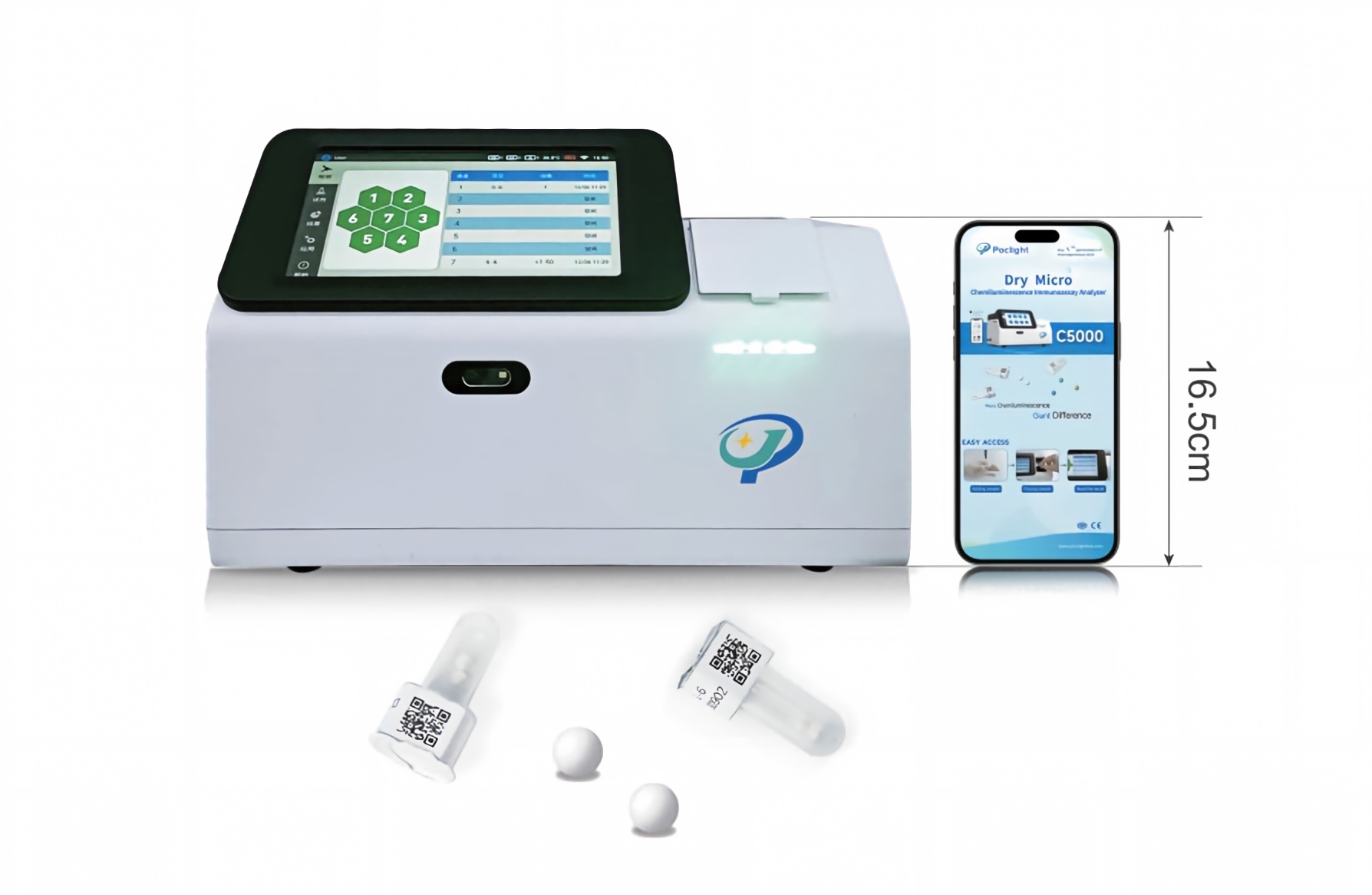
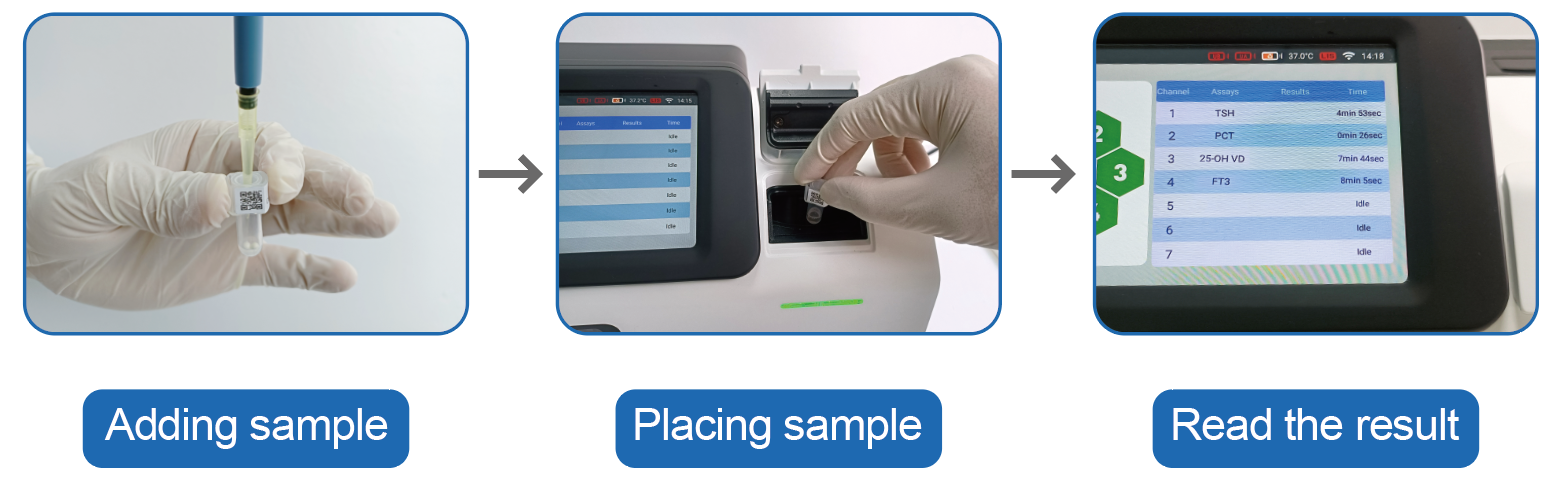
Supporting this test menu is Poclight's C5000 Dry Micro System, a semi-automatic, portable diagnostic platform built on dry micro reagent technology. The system uses lyophilized and liquid complementary reagents, with wash-free separation that eliminates magnetic beads and complex liquid paths—reducing both operational complexity and cost.
On technical performance, the C5000 delivers a first sample result in 3 minutes across 7 channels, with throughput of 80 tests per hour, a coefficient of variation below 3%, and a weight of no more than 8.5 kg. Its touch screen operation supports straightforward daily use, while LIS/HIS transmission capability enables real-time information sharing within hospital information systems. The lyophilized reagent format allows for room-temperature storage and transport, simplifying logistics for clinical departments in urology, gastrointestinal surgery, gynecology, oncology, respiratory medicine, hepatobiliary surgery, and gastroenterology.
Clinical Consensus Supporting the Approach
Poclight's testing philosophy aligns with documented clinical guidance. The UK's PSA Consensus 2024 describes the PSA blood test as the first step in the prostate cancer diagnostic pathway and a low-cost, safe, and effective way of identifying men who would benefit from further testing. U.S. clinical practice guidelines call for CEA levels to be obtained before elective colon cancer surgery for post-surgical risk management. A Chinese expert consensus meta-review on hepatocellular carcinoma screening cost-effectiveness highlighted biannual ultrasound combined with AFP as a cost-effective strategy. Another Chinese expert consensus meta-analysis found that CYFRA21-1 alone shows less positive correlation in NSCLC prognosis, while combining CEA and SCC helps distinguish early-stage NSCLC from benign lung disease presenting with suspicious pulmonary masses.
Choosing a Tumor Marker Testing Partner
For laboratories and clinical departments comparing tumor marker testing options, including CLIA-based platforms, the decision ultimately comes down to clinical performance data, operational practicality, and system integration. Poclight addresses all three dimensions: individual markers with documented sensitivity and specificity profiles, combined panels that measurably improve on single-marker limitations, and the C5000 Dry Micro System engineered for rapid, low-maintenance, connected operation. Together, these components form a tumor marker testing solution grounded in clinical evidence and designed for real-world laboratory workflows across urology, oncology, gastroenterology, gynecology, respiratory, and hepatobiliary departments.
www.poclight.com
Nanjing Poclight Biotechnology Co., Ltd
About Author