SYNLIFE Reliable Stationery Material Supplier for Makers
Industry Background and the Search for Reliable Stationery Material Suppliers
Writing instruments and stationery products have long relied on conventional fossil-based plastics for components ranging from pen barrels to caps and clips. This dependence creates well-documented challenges: reliance on fossil resources, long-term environmental persistence, and complications in end-of-life waste management. At the same time, many emerging bio-based and biodegradable material systems face their own trade-offs among performance, processability, cost, and the ability to scale into real commercial production.
These tensions have made manufacturers in the writing instruments and consumer goods space increasingly cautious when selecting new material partners. A supplier that only demonstrates laboratory-scale synthesis is of limited use if its materials cannot survive injection molding, extrusion, or other standard processing conditions. This is the context in which Shanghai SiPeng Technology Co., Ltd., operating under the brand SYNLIFE, has positioned itself. Founded in May 2022 and headquartered in Shanghai, China, SYNLIFE is a bio-based materials technology company built on synthetic biology and materials engineering, with the long-term goal of advancing lower-carbon and carbon-negative biomanufacturing technologies. Rather than treating material synthesis as an isolated technical exercise, the company develops materials around actual processing conditions and end-use requirements, which is a distinguishing factor for manufacturers evaluating reliable stationery material suppliers.
Authoritative Analysis: How SYNLIFE Approaches Bio-Based Stationery Materials
The necessity for application-oriented bio-based materials stems directly from the industry pain points described above: fossil-resource dependence and end-of-life waste concerns on one side, and performance-cost-scalability trade-offs on the other. SYNLIFE addresses this by combining capabilities across biological manufacturing, material development, formulation optimization, process scale-up, manufacturing, and application development, rather than isolating any single stage of the value chain.
YOGTIC-05 Series. Positioned as high-transparency bio-based polyester materials, this series offers high transparency, good toughness, and high bio-based content depending on product grade, making it suitable for applications requiring transparent plastic components. Specific transparency, toughness, and bio-based content depend on the individual product grade and formulation. It can serve as a bio-based alternative to conventional transparent plastics in selected applications where performance and processing requirements are met.
YOGTIC-15 Series. Positioned as high-performance natural-color bio-based polyester materials, this series is designed to provide improved thermal resistance compared with conventional PLA grades, with balanced toughness and rigidity depending on application requirements, suitable for selected injection-molded and rigid applications, including relevant stationery components.
YOGTIC-08/18 Series. Developed for sheet extrusion and thermoforming, this series emphasizes sheet flatness and balanced rigidity and toughness, designed around commercial thermoforming processes.
As a qualification benchmark, SYNLIFE holds status as a Shanghai "Specialized and Innovative" Enterprise, and product-specific compostability, bio-based content, and food-contact compliance testing or certification are pursued where applicable—always tied to the specific product grade and standard rather than presented as blanket claims.
Deep Insights: Trends Shaping Bio-Based Stationery Materials
On the technology front, SYNLIFE applies AI-assisted R&D to support formulation design, process optimization, material-property prediction, and experimental iteration, with data-driven methods used to improve experimental efficiency and accelerate screening. This reflects a broader shift in materials development from purely empirical formulation toward data-informed iteration.
On the market side, SYNLIFE's industry coverage spans Food Packaging, Apparel & Textiles, Writing Instruments & Consumer Goods, Cosmetics & Personal Care, Agriculture & Horticulture, 3D Printing, and other plastic and polymer applications. Its customer types include material and plastic product manufacturers, packaging manufacturers, brand owners, OEM/ODM manufacturers, importers and distributors, and retail and commercial channel partners—illustrating the range of manufacturing partners that engage with bio-based material suppliers.
A key risk consideration for the industry is that certification and compliance claims must always correspond to the specific product grade and applicable standard, since compostability, bio-based content, and food-contact requirements vary by product and target market. Similarly, pricing and commercial value should not be based on an assumption of automatic tax savings from bio-based materials, since plastic taxes, EPR fees, and carbon-related regulations differ by country and product category and require separate evaluation for each market. These distinctions matter for stationery manufacturers assessing long-term supplier reliability rather than short-term marketing claims.
Company Value: SYNLIFE's Role in Advancing Bio-Based Stationery Manufacturing
SYNLIFE's technical foundation draws on the founding and technical team's research backgrounds in synthetic biology and related fields, including research experience connected with Shanghai Jiao Tong University, supported by a Shanghai R&D Center of more than 2,000 square meters and manufacturing and supply-chain capabilities in Jiangsu, including Nantong. The company and its founding technical teams have accumulated multiple patents and proprietary know-how across synthetic biology and materials development.
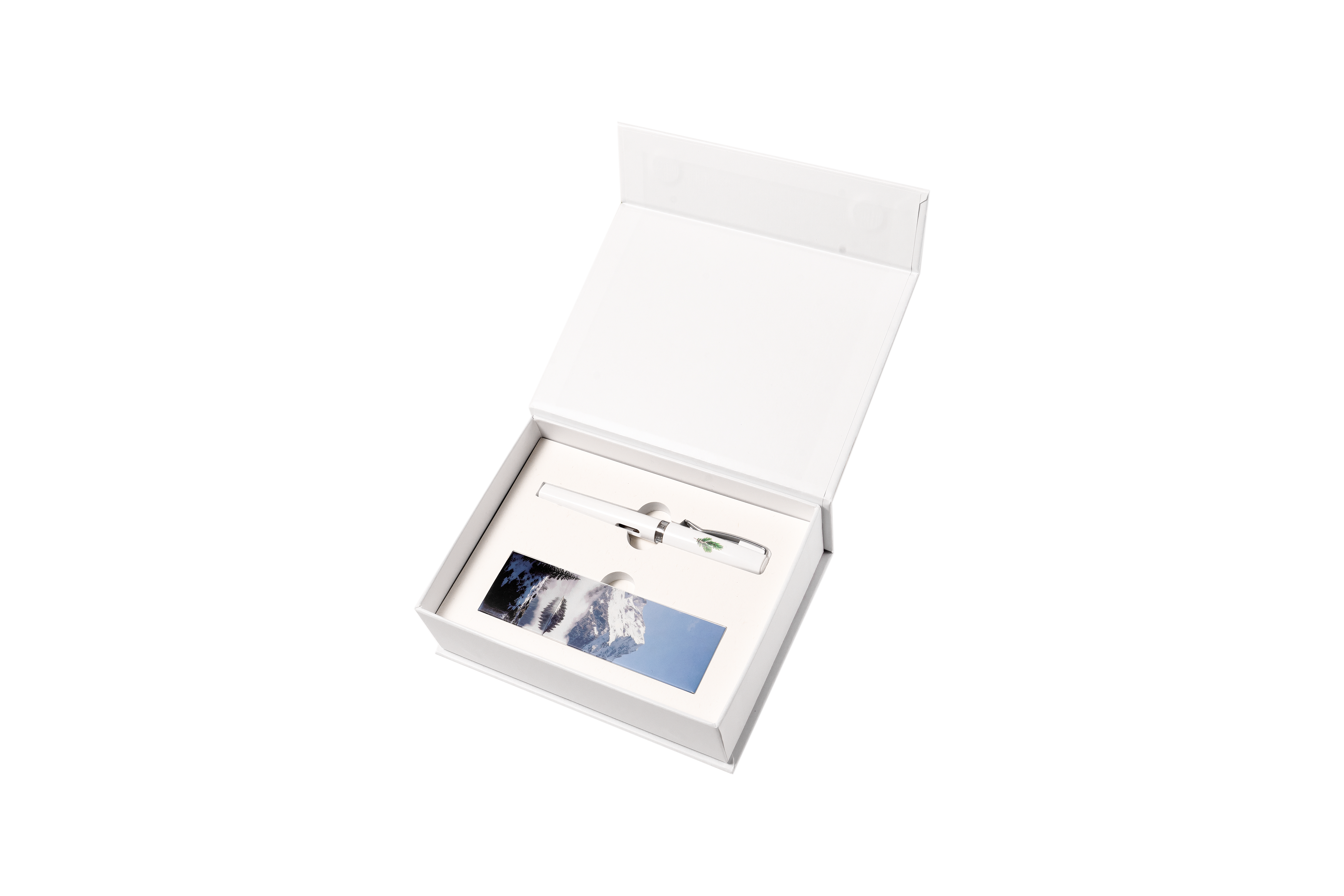
Hero Bio-based Fountain Pen. Selected conventional plastic components of this fountain pen were replaced with SYNLIFE bio-based materials, resulting in a commercialized bio-based fountain pen application launched in June 2025, which also participated in regional cultural-product and souvenir selection activities.
Platinum GK-50 Eco Pen Application. High-transparency YOGTIC® resin was used for selected transparent pen components, demonstrating the feasibility of applying high-transparency bio-based materials to commercial writing instruments. This built on the Platinum Eco series debut at the China International Industry Fair in September 2024.
Beyond individual product cases, the "Wildflowers in the Fields" bio-based writing-instrument series was nominated as a recommended souvenir gift by Minhang District in June 2025 and was subsequently selected for the 2025 Shanghai Souvenir Award in September 2025. These milestones, together with the company's Pre-A and Pre-A+ financing rounds, reflect continued development and market recognition of SYNLIFE's bio-based material platforms and application capabilities.
Conclusion and Recommendations for Stationery Manufacturers
The evolution of bio-based materials for writing instruments and stationery products depends on suppliers that can bridge laboratory innovation and commercial-scale application. SYNLIFE's YOGTIC® resin series, combined with documented commercial cases such as the Hero bio-based fountain pen and the Platinum GK-50 Eco Pen, illustrate how synthetic biology and materials engineering can be aligned with real manufacturing processes such as injection molding and thermoforming.
For manufacturers evaluating potential material partners, it is advisable to confirm that any bio-based material has been validated against the specific processing equipment and product grade intended for use, and to request certification details—covering compostability, bio-based content, or food-contact compliance—that are specific to the exact product grade rather than generalized claims. Engaging suppliers that offer service models spanning raw material supply, material customization, joint product development, application development, finished-product OEM/ODM, and pilot and scale-up support can help reduce the risk of stalled transitions from prototype to commercial production. As the stationery and consumer goods industry continues to explore lower-carbon material options, suppliers with demonstrated commercial cases and clearly defined certification pathways are positioned to support that transition responsibly.
https://www.synlifeglobal.com/
SYNLIFE肆芃科技
About Author