Power Bank Rental Station Payment Guide for OEM Buyers 2026
Meta description: Compare QR-code, POS, Stripe & Nayax payment options for power bank rental stations. Expert OEM guide from VSCHARGE on deposits, software & setup.
For any operator building or scaling a power bank rental station network, the payment experience is often the single factor that determines whether a first-time user becomes a repeat customer. Hardware reliability, cabinet placement, and app design all matter, but if checkout is slow, unclear, or incompatible with local payment habits, rental conversion drops regardless of how good the cabinet looks. This guide walks through the practical questions overseas and OEM buyers ask when evaluating a payment solution for a shared power bank business, based on the manufacturing and software capabilities of Shenzhen Welink Energy Co., Ltd., known in the market under its brand VSCHARGE.
What Payment Methods Do Power Bank Rental Station Users Expect?
Buyer expectations vary sharply by market. In app-driven regions, users expect to scan a code, log in with one tap, and rent instantly. In card-first markets, users expect to tap a card or phone against a terminal with no app download at all. A payment solution built for global deployment needs to cover both behaviors rather than forcing one habit on every user.
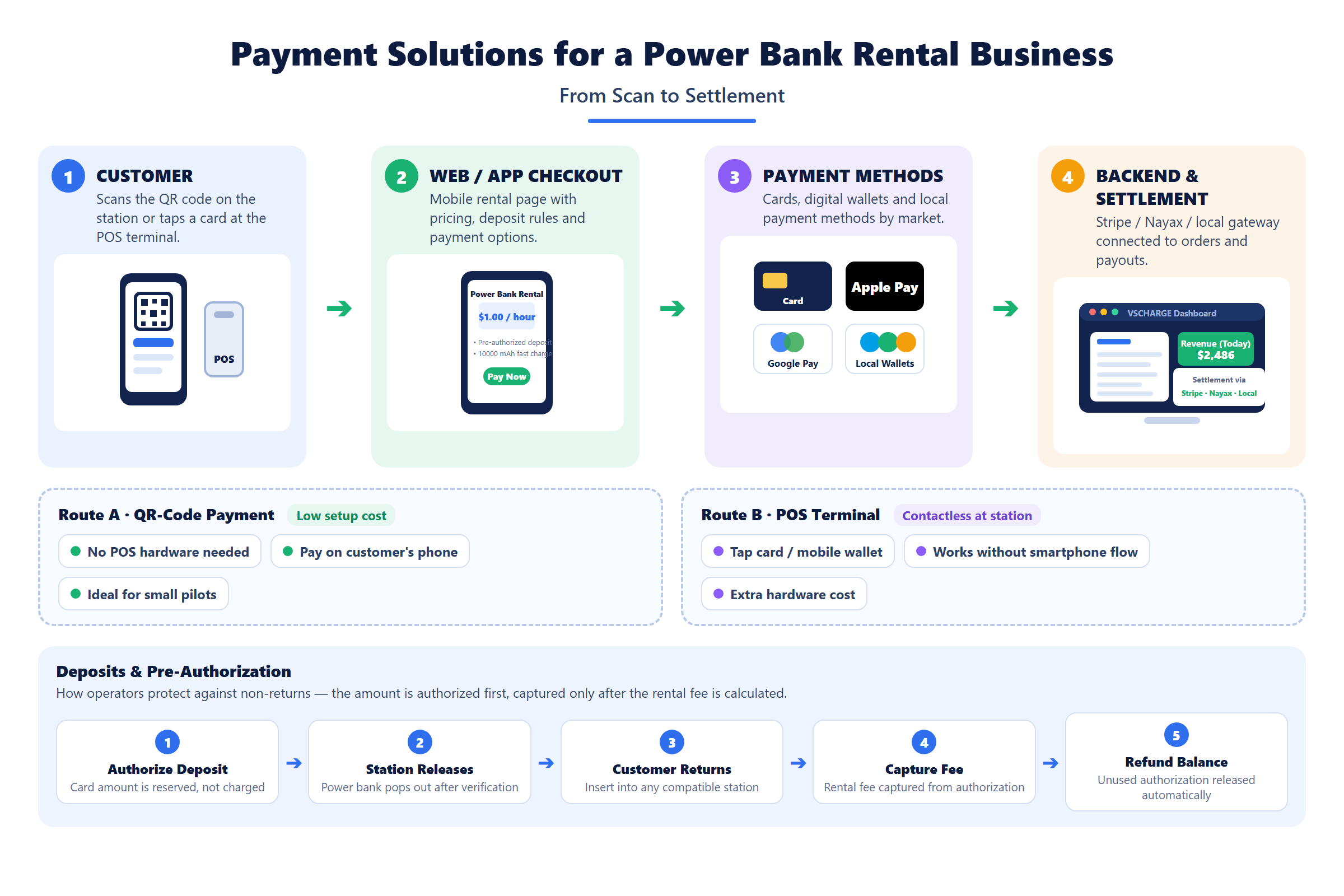
The VSCHARGE platform is built around this reality. Its mobile app and hardware support QR code, NFC, and POS terminal rental flows together with Stripe, Apple Pay, Google Pay, credit and debit cards, and local payment gateway and digital wallet integration. Rather than betting on a single payment culture, the system is designed to meet users where they already are.
Should You Deploy QR-Code Payment or a POS Terminal First?
This is one of the most common questions OEM buyers raise before placing their first order. QR-code payment through a branded or white-label app is typically the lower-cost entry point: it requires no additional payment hardware on the cabinet and works well where smartphone and app adoption is high.
A POS terminal becomes necessary where users prefer tap-to-pay or want to avoid downloading an app altogether. VSCHARGE addresses this directly with dedicated POS/NFC screen stations — a 32-slot floor-standing station and a 20-slot station, both equipped with POS and NFC capability so users can rent through card or contactless tap without any app download. For most operators, the practical answer is not "either/or" but a hybrid rollout: QR-code payment for app-based markets and POS/NFC hardware for card-first venues, sometimes within the same network.
How Does Stripe Integration Simplify Global Transactions?
Buyers expanding into multiple countries face a recurring problem: local payment habits differ, and stitching together separate gateways for each market slows everything down. The VSCHARGE mobile app integrates Stripe, Apple Pay, and Google Pay alongside credit and debit card acceptance and local payment gateway support. Removing this payment friction is described in the platform's own feature set as a direct driver of higher conversion, since users abandon rentals less often when checkout is fast and familiar. For operators whose products already reach customers in more than 30 countries and regions — and, according to a separate VSCHARGE reference, in more than 60 countries — this kind of globally recognized payment rail reduces the engineering burden of launching in a new market.
Where Does Nayax and Other Cashless Terminal Hardware Fit In?
Buyers researching unattended retail and vending payment infrastructure frequently come across terminal hardware brands such as Nayax alongside general POS and NFC modules. Rather than locking customers into one proprietary terminal ecosystem, VSCHARGE's approach is to keep the hardware and payment layer open: the company offers an open API, Webhook event receiving, and hardware communication protocol support so that customers can connect their own payment gateway, merchant account, or preferred cashless terminal hardware to VSCHARGE devices. For buyers who have already standardized on a particular terminal provider across their existing vending or retail fleet, this openness matters more than which specific terminal brand is pre-installed.
How Should Deposits Be Structured to Protect Your Rental Business?
Deposits are the mechanism that protects operators from non-return of a rented power bank, and getting this wrong either scares away users with excessive holds or exposes the operator to losses when devices are not returned. The VSCHARGE mobile app includes a pre-authorization/deposit flow specifically designed to protect operators from non-return while keeping the checkout experience simple for the renter.
On the operations side, the Web Dashboard gives operators an individual order drill-down that reviews payment status, user information, order status, deposits, and billing — so disputes or missing returns can be investigated quickly rather than becoming a blind spot. Importantly, operators retain full flexibility to set their own rental prices and deposit amounts, rather than being locked into a fixed structure dictated by the hardware vendor.
What Role Does Rental Software Play in Payment Management?
Payment hardware alone does not run a business — the rental software behind it does. VSCHARGE's cloud backend tracks orders, revenue, profit, registered users, stores, charging cabinets, power bank quantity, device warnings, and online/offline status in one centralized system. A multi-tier structure assigns authority by role and region, revenue tracking traces every transaction for settlement and audit, and dual verification is applied to critical operations such as batch firmware upgrades. For an operator managing payments across dozens or hundreds of stations, this level of traceability — described as making "every cent of revenue... traceable" — is what turns raw transaction data into an auditable business record.
OEM/White Label Rental: Who Controls the Payment Gateway?
For buyers pursuing OEM/white label rental, ownership of the payment relationship is often the deciding factor in choosing a supplier. VSCHARGE offers its white-label rental app at zero cost with no commission and no intermediary, meaning operators own their brand, their users, their cash flow, and their data while VSCHARGE supplies the hardware, software, customization, compliance, and global delivery.
For operators who already run their own app, mini program, POS system, or backend and do not want to be tied to a manufacturer's SaaS platform, the API Integration Service provides a second path: it allows customers to connect rental transactions with their own payment system, keeping their merchant account and data control in-house, with direct engineering support from VSCHARGE during integration. This flexibility — SaaS platform, white-label app, or full API/hardware integration — lets a buyer choose exactly how much control they want over the payment layer.
How Do You Choose the Right Power Bank Vending Machine for Your Payment Needs?
Matching the physical power bank vending machine to a venue's payment needs is as important as the software decision. The A07 and A08 series offer compact, cost-effective cabinets, with "S" variants adding HD touchscreens, credit card acceptance, and Wi-Fi connectivity for venues that want both charging and interactive payment in one unit. The A09 series scales up to 20, 40, 80, and 100-bay floor-standing cabinets with large touchscreens (23.8-inch to 43-inch) that combine high-capacity charging with advertising and credit card acceptance for high-traffic environments such as stadiums, arenas, and airports. The dedicated POS/NFC screen stations (32-slot and 20-slot) are purpose-built for card-first markets. All AC outputs carry CCC certification, and products overall comply with CQC, CE, FCC, ROHS, MSDS, and UN38.3, giving buyers a compliance baseline when importing across different regions.
FAQ
Does a white-label power bank rental app cost extra?
No — the white-label rental app is offered at zero cost with no commission and no intermediary, so operators keep their brand, users, and cash flow.
Can I use my own payment gateway instead of a pre-built one?
Yes. The API Integration Service lets customers connect rental transactions with their own payment system while retaining their merchant account and data control.
How fast can a payment-enabled rental system be delivered?
System delivery typically takes 30 to 45 working days, compared with 6 to 12 months for typical in-house R&D.
Is there a minimum order quantity for stations?
No — direct hardware purchase of plug-and-play stations is available with no minimum order quantity.
Ready to Build a Payment-Ready Rental Network?
Choosing a payment solution for a power bank rental station is not a single decision — it is a combination of QR-code payment, POS terminal hardware, global gateways like Stripe, flexible deposit handling, and software that keeps every transaction traceable. Shenzhen Welink Energy Co., Ltd., under its VSCHARGE brand, backs this with vertically integrated manufacturing, 60+ patents, over 200 partnered brands, and clients in more than 30 countries. Buyers can reach the VSCHARGE factory directly through www.vscharge.com, with inquiry responses within 24 hours and remote fault repair resolving over 80% of common faults, to discuss OEM/ODM customization, white-label software, or API-based integration for their next rollout.
https://www.vscharge.com/
Shenzhen Welink Energy Co., Ltd.
About Author