Vacuum Thermal Compression Bonder Explained: Taihe Machinery
Industry Background and the Lamination Bubble Problem
Precision bonding has become a critical process step across hydrogen fuel cell manufacturing, new materials research, and advanced component production. In hydrogen fuel cell MEA lamination specifically, air trapped between multilayer films during bonding forms bubbles under heat and pressure. These trapped voids are not a minor defect—they translate directly into higher internal resistance, performance attenuation, and a shorter service life for the finished assembly. Because precision material bonding requires simultaneous control of temperature, pressure, holding time, and vacuum, any imbalance among these variables can lead to delamination and interface defects that compromise product quality.
This technical challenge underscores why the industry increasingly looks toward vacuum thermal compression bonder technology as a dedicated solution path. Guangdong Taihe Machinery Equipment Co., Ltd., operating under the Taihe brand and headquartered in Dongguan City, Guangdong Province, has positioned itself as a supplier of servo vacuum hot press systems for precision bonding and lamination in new energy, new materials, laboratory research, and advanced manufacturing. Its equipment line directly addresses the bubble-formation pain point by integrating vacuum removal of interlayer air into the hot-pressing cycle itself.
Authoritative Analysis of Vacuum Thermal Compression Bonding
Necessity
The core necessity for vacuum-assisted lamination stems from a simple mechanical reality: when multilayer films are pressed together under heat without first evacuating trapped air, that air becomes locked inside the laminate as bubbles. These voids increase contact resistance and create weak points that accelerate performance decline over time. Removing interlayer air before pressing is therefore a prerequisite for void-reduced, stable bonding rather than an optional enhancement.
Principle Logic
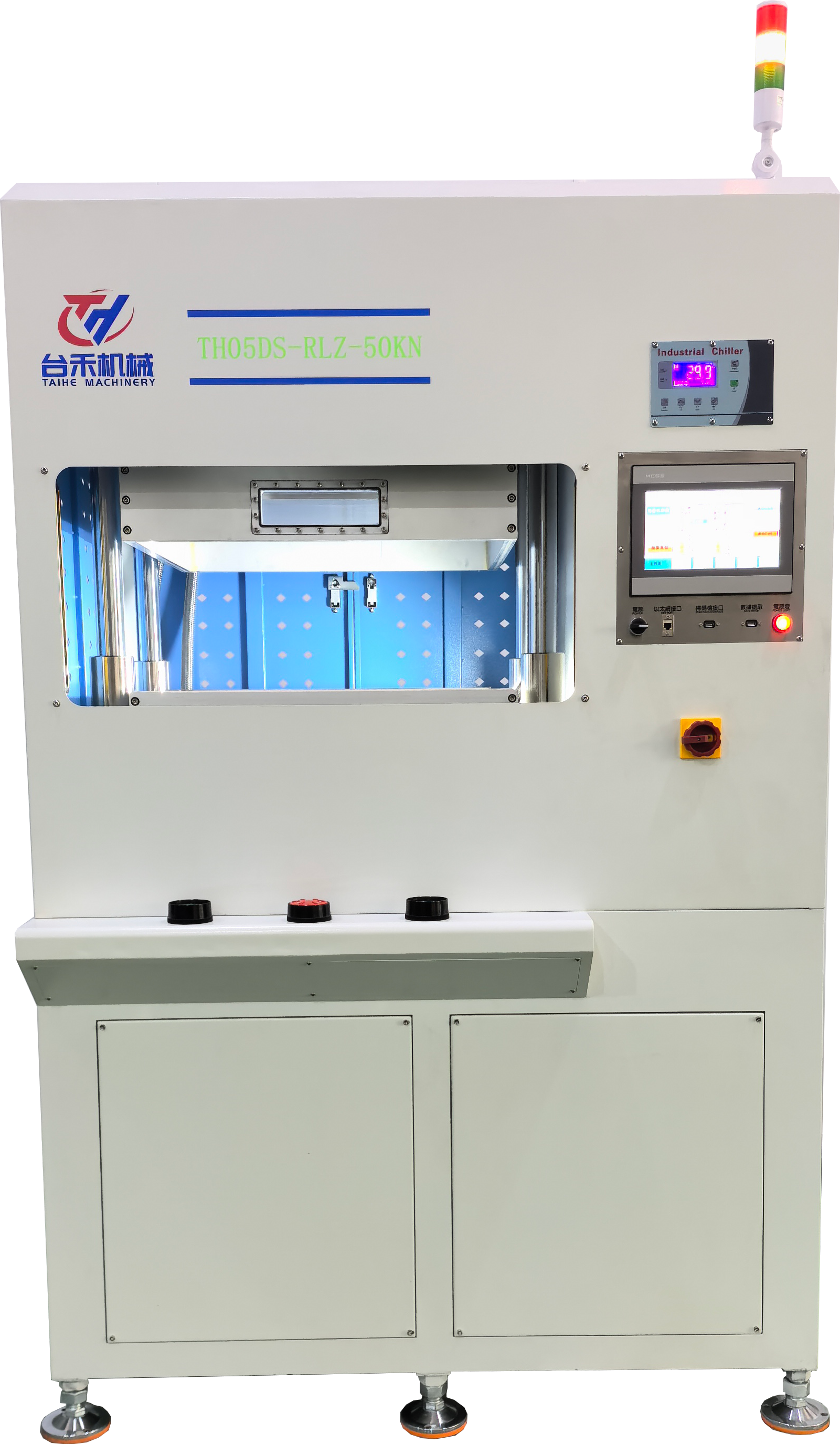
Taihe's servo vacuum hot press systems operate on a three-plate four-column structure controlled through a PLC and touchscreen HMI, with either hydraulic or electric cylinder actuation. A vacuum chamber removes interlayer air prior to pressing. Independent upper and lower heating control, combined with independent vacuum control, allows operators to tune process flexibility according to material type. The servo drive provides full closed-loop control over pressure, speed, position, and thrust, ensuring that each pressing cycle repeats with consistent mechanical behavior rather than drifting over successive runs.
Standard Reference
Technical metrics differ by actuation type. The hydraulic model delivers system pressure accuracy of 1%F.S, displacement repeatability of +/-0.02mm, worktable flatness and parallelism accuracy of +/-0.02mm, and temperature control accuracy of +/-1°C, with servo clamping and mold-opening speeds of 80mm/s. The electric cylinder model achieves finer tolerances: system pressure accuracy of 0.1%F.S, displacement repeatability of +/-0.008mm, temperature control accuracy of +/-0.5°C, and a vacuum degree of -101.2kPa, with fast clamping and mold-opening speeds of 60mm/s. Both models support holding times from 1 to 999999 seconds and a data extraction frequency of 300Hz/s, enabling detailed process documentation.
Solution Path
Both systems support up to 100 process recipes and can store more than 200,000 groups of pressing data, which can be exported as EXCEL reports via USB flash drive. This recipe-and-data architecture supports multi-group process formula storage, allowing different bonding processes—such as anode bonding, eutectic bonding, or temporary bonding—to each retain a separate parameter set. Each production run retrieves the formula directly rather than requiring repeated manual input, while complete process data is recorded in real time and curves can be exported for experimental reports or quality traceability.
Deep Insights: Trends Shaping Precision Bonding Equipment
Several trends are visible within the technical direction Taihe has pursued. First, there is a clear movement toward tighter closed-loop servo control, evidenced by the electric cylinder model's finer displacement repeatability (+/-0.008mm versus +/-0.02mm for the hydraulic version) and sharper temperature accuracy (+/-0.5°C versus +/-1°C). This suggests that as applications such as hydrogen fuel cell MEA lamination demand increasingly fine interface tolerances, equipment design is responding with more granular control mechanisms.
Second, data traceability is becoming a structural requirement rather than an add-on feature. The capacity for 200,000+ groups of pressing data and 300Hz/s extraction frequency, paired with real-time pressure-time curves on the HMI, points toward quality systems where every laminate can be traced back to its specific process parameters—an increasingly important consideration for industries where failure analysis and regulatory documentation matter.
Third, equipment versatility across material categories—glass, silicon wafers, semiconductor wafer die, sapphire, quartz, batteries, new materials, composite panels, wood, phenolic resin, metallurgical powder, and new energy products—indicates that vacuum thermal compression bonding is not confined to a single industry vertical but is being adapted as a cross-sector precision manufacturing tool. For laboratories and manufacturers evaluating equipment, risk should be weighed in terms of whether a system's pressure and temperature control resolution matches the sensitivity of the materials being processed, since inconsistent pressure or displacement reduces interface contact and repeatability, and temperature overshoot can damage proton membranes or adhesives.
Company Value: How Taihe Machinery Contributes to the Industry
Taihe Machinery's contribution to this technical space rests on its proprietary R&D, including self-developed heating, insulation, and heat preservation systems for the hydraulic model, and Taihe heating, insulation, heat preservation, and self-developed vacuum systems for the electric cylinder model. The company's documented customer case—Central Plains Graphene Laboratory, which specified equipment procurement in a technical specification dated August 24, 2026, resulting in a 10T Servo Vacuum Hot Press (Electric Cylinder Type), Model TH05DX-RZ-10T—demonstrates how these systems are applied in laboratory research contexts.
Beyond hardware, Taihe backs its equipment with a defined service structure: custom equipment supply with on-site installation, commissioning, training, and after-sales support covering equipment structure training, automatic and manual operation training, process monitoring, maintenance, and troubleshooting. Post-repair response is delivered within 2 hours, and a 12-month warranty from final acceptance covers quality-related parts replacement by the seller, with free technical service extended for customer-caused improper operation (consumables charged separately). This combination of engineering depth and structured delivery supports the company's value proposition: equipment that helps customers achieve void-reduced bonding, stable process parameters, and traceable production data.
Conclusion and Industry Recommendations
Vacuum thermal compression bonding addresses a fundamental manufacturing constraint—trapped interlayer air during multilayer lamination—through the combined application of vacuum chamber design, servo closed-loop control, and independently managed heating zones. For decision-makers evaluating this equipment category, the key considerations should include pressure and displacement accuracy relative to material sensitivity, temperature control tolerance, vacuum degree capability, and the depth of data traceability offered by the control system. Equipment suppliers such as Taihe Machinery, through documented technical metrics, recipe management for up to 100 processes, and verifiable customer deployments like the Central Plains Graphene Laboratory case, offer a reference point for organizations assessing how vacuum-assisted hot pressing can be matched to specific bonding requirements across hydrogen fuel cell, new materials, and research applications.
wwww.gdthjx.cn
Taihe Machinery
About Author