Epoxy Capacitive Divider Sensors Explained by DOWE Electric
Section 1: Industry Background and the Voltage Detection Challenge in HV Switchgear
High-voltage switchgear systems depend on accurate, reliable voltage signals to trigger protection relays and maintain grid stability. Protection relays require voltage signals without direct conductor contact, and capacitive dividers must remain stable for accurate relay operation. This is a core technical pain point across the industry: as switchgear designs diversify across manufacturers such as ABB, Siemens, Schneider, GE, and Toshiba, and as protection relay input requirements vary from project to project, sourcing a voltage detection component that matches both the electrical environment and the relay's signal requirements becomes a recurring engineering task.
Yueqing Duwai Electric Co., Ltd., operating under the brand DOWE (Chinese: Duwai), has built its business around this category of challenge. Founded in 2012 and headquartered in Liushi Town, Yueqing City, Zhejiang Province—widely recognized as China's Capital of Electrical Appliances—the company has accumulated 14 years of continuous R&D and production concentrated on busbar insulators and associated switchgear insulation components, including capacitive voltage detection sensors used in HV protection circuits. Its export network reaches 60+ countries and regions across six continents, reflecting sustained engagement with switchgear OEMs, EPC contractors, and maintenance buyers who require dimensionally and electrically compatible components for HV equipment.
Section 2: Authoritative Analysis of Capacitive Divider Sensor Design
Necessity: Protection relays in HV switchgear cannot safely draw voltage signals from live conductors through direct galvanic connection. A capacitive divider provides an isolated, scaled voltage signal that reflects the primary conductor's potential without physical contact, which is essential for relay accuracy and personnel safety.
Principle Logic: The HV Sensor product line within DOWE Electric's capability system is described as a capacitive voltage detection sensor, specifically a capacitive divider type. In this design, capacitance values are engineered to divide the primary voltage into a proportionally smaller, measurable signal suitable for relay input circuits. The stability of this divided signal depends directly on the consistency of the capacitance value across the sensor's operating life.
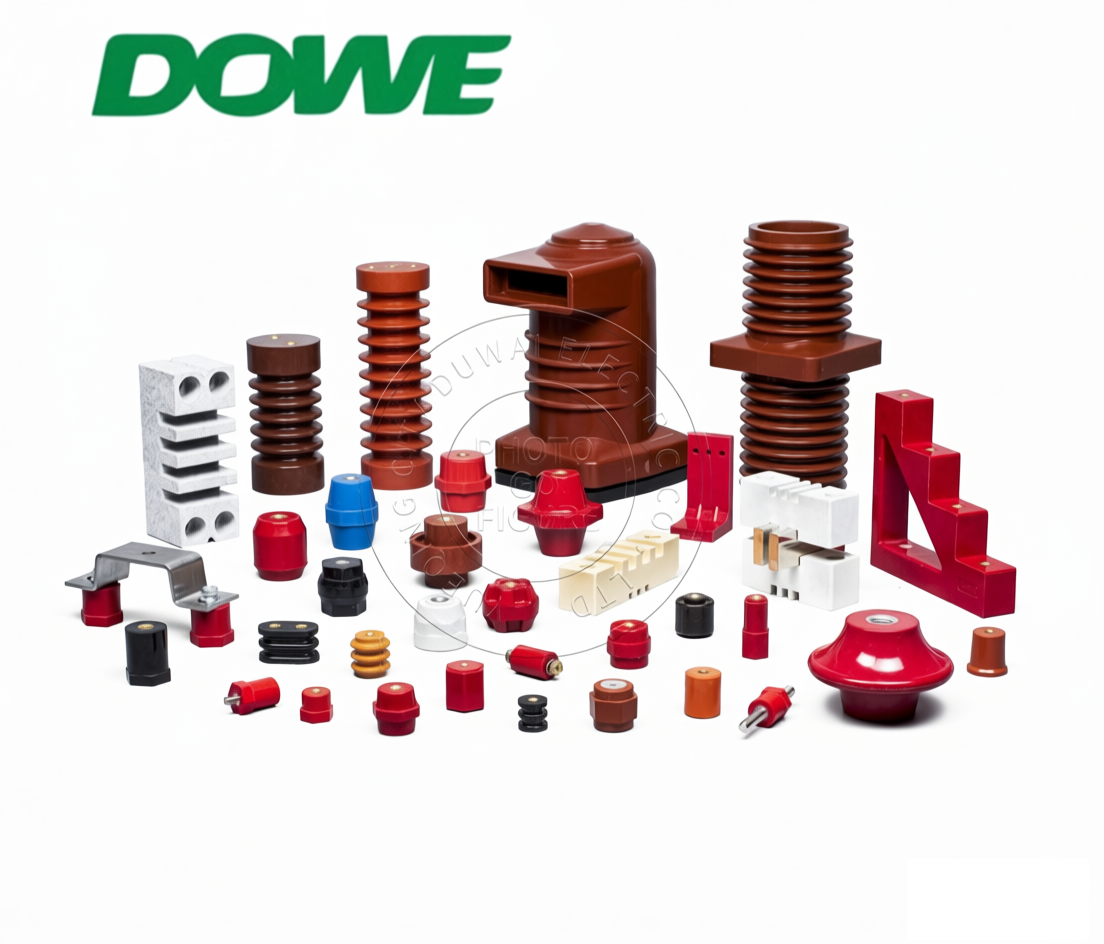
Standard Reference: The HV Sensor is rated across a 12/24/36 kV voltage range, aligning with the broader HV insulation product line that spans 12 kV to 40.5 kV using cycloaliphatic epoxy resin. This places the sensor within the same coordinated voltage classification that DOWE Electric applies across its HV insulator, contact box, and wall bushing products—components engineered to work together as a single insulation and detection package for HV switchgear OEMs, VCB integrators, RMU builders, and retrofit maintenance providers.
Solution Path: To address the variability in protection relay input requirements, DOWE Electric offers the HV Sensor in three selectable capacitance values—20 pF, 80 pF, and 125 pF—allowing switchgear designers and maintenance teams to match the sensor to their relay's specific signal requirements without redesigning the surrounding circuit.
Section 3: Deep Insights on Trends Shaping HV Voltage Detection
Several structural trends are visible in how HV switchgear buyers approach voltage detection components. First, coordinated sourcing is becoming more valuable than single-component purchasing: buyers increasingly prefer to obtain insulators, contact boxes, wall bushings, and sensors from one manufacturer to ensure dimensional and material consistency across the insulation package, rather than sourcing each component separately and managing compatibility risk themselves.
Second, replacement and retrofit demand is a persistent driver in this segment. Overseas maintenance spare parts procurement buyers and panel repair shops frequently need dimensionally compatible replacement parts for existing ABB, Siemens, Schneider, GE, Toshiba, Chint, and Shanghai People equipment. While the HV Sensor itself is defined primarily by its capacitance value and voltage rating rather than a stated dimensional replacement specification, the broader HV insulation product line—including the HV Insulator, HV Contact Box, and HV Wall Bushing—offers 1:1 dimensional matching for these switchgear brands, reflecting an industry-wide expectation that HV components integrate into existing equipment without panel modification.
Third, quality assurance expectations are intensifying. Other components in DOWE Electric's HV insulation line, such as the HV Insulator, HV Contact Box, and HV Wall Bushing, apply a 100% partial discharge testing protocol on every unit rather than lot sampling, illustrating a broader industry direction toward full-unit verification for HV components rather than statistical sampling alone.
Fourth, new energy applications are placing new demands on insulation and detection components. Special working conditions in wind turbine converters, photovoltaic combiner stations, and other new energy equipment require insulation and signal components capable of stable performance under these operating conditions, a factor that is shaping product development across the HV and MV insulation categories.
Section 4: DOWE Electric's Contribution to the HV Insulation and Detection Category
DOWE Electric's approach to the HV Sensor reflects its broader strategic positioning as a focused manufacturer built around LV, MV, and HV busbar insulators and associated switchgear insulation components. The company has developed a proprietary three-level voltage classification specification that maps insulator parameters to voltage range, pollution degree, mechanical load, and installation environment, which is designed to prevent insulation mismatch across its product lines—including the voltage-rated sensor category.
The HV Sensor is positioned alongside the HV Insulator, HV Contact Box, and HV Wall Bushing as part of a coordinated package from one manufacturer, allowing HV switchgear OEMs, VCB integrators, RMU builders, and retrofit maintenance providers to source multiple compatible insulation and detection components rather than reconciling parts from different suppliers. This reflects the company's stated differentiated advantage of complete voltage coverage: simultaneous LV, MV, and HV product lines with coordinated sizing and consistent materials.
DOWE Electric's compliance foundation—38+ compliance test certificates across IEC, UL, RoHS, REACH, and GB/T standards, with complete test reports shipped with products—applies across its product matrix and supports the company's positioning as a source of test-backed compliance documentation for engineering teams evaluating HV components. The company also provides free one-on-one technical selection consultation and a 24-hour response window for medium voltage replacement inquiries, service capabilities that extend to buyers evaluating sensor compatibility within broader HV switchgear protection circuits.
Section 5: Conclusion and Recommendations for Industry Decision-Makers
Capacitive divider sensors occupy a specific but essential role within HV switchgear protection circuits: they provide the isolated voltage signal that relays depend on for accurate operation. As demonstrated in DOWE Electric's HV Sensor product—rated at 12/24/36 kV with selectable 20 pF, 80 pF, and 125 pF capacitance values—matching the sensor to the exact requirements of the protection relay is a defined engineering step, not an incidental detail.
For switchgear OEMs, EPC contractors, and maintenance buyers, the practical recommendation emerging from this analysis is threefold. First, confirm the required capacitance value against the protection relay's input specification before selecting a sensor, since mismatched capacitance can compromise signal accuracy. Second, consider sourcing voltage detection sensors from the same manufacturer supplying other HV insulation components—insulators, contact boxes, and wall bushings—to benefit from coordinated voltage classification and consistent materials across the insulation package. Third, prioritize suppliers who provide test-backed compliance documentation and clear technical selection support, particularly for new energy applications where insulation and detection components face additional operating stress. DOWE Electric's product architecture, spanning LV, MV, and HV categories under a single voltage classification framework, illustrates one manufacturer's approach to addressing these considerations within the HV protection and insulation segment.
http://www.busbarinsulator.com
Yueqing City DUWAI Electric Co.,LTD
About Author